

Probably not. You can pay your side-business federal taxes through paycheck withholding. The fact that your employer withholds something doesn’t mean it’s enough. I would compare your anticipated household tax to your expected withholding, and check both the rules that protect against a penalty and when the payments are considered made.[1][3]
This is federal planning for tax year 2026, using your 2025 return where the prior-year rules apply. The objective isn’t to choose a savings percentage. The idea is to determine when enough has been paid to not incur an underpayment penalty versus enough has been paid to not have a tax due when you file.[1]
The paycheck number that matters
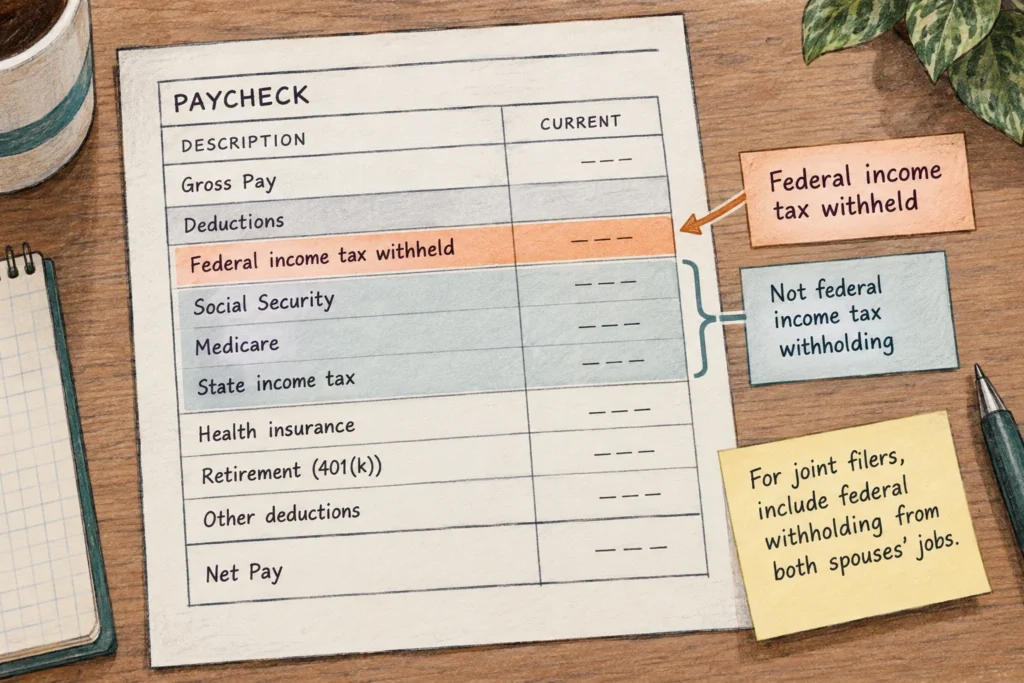
I’ll give an imagined example. In the example, I’m opening a paystub after a client payment has been made. I think, “Great, I’ve paid enough tax!”, until I realize the total includes Social Security, Medicare and state taxes. I’m less pleased with my shortcut. To get an idea of federal income tax, I look at the Federal income tax withholding line, and am relieved to find it’s a more comfortable amount.
A simple starting point to figure net business profit for a side-business is: gross receipts minus deductible business expenses. Profit isn’t your tax, and sales certainly aren’t your tax. Profit gets reported on your personal income tax return, and results in a self-employment tax as well. It’s for that reason I wouldn’t use a flat percentage of sales to answer the question.[1][2]
To complete the federal worksheet for 2026, you'll need your current pay stubs for all household jobs for you, your spouse if filing jointly, and a realistic projection of profit for 2026. You'll also need your 2025 tax return. The IRS Tax Withholding Estimator can be used to align your household withholding. You'll want to include the federal income tax withholding, but not the payroll Social Security and Medicare tax withholding. The 2026 Form 1040-ES can be used to project your federal income tax, your self-employment tax, and other federal taxes. It can also be used to project credits you might be eligible for.[1][4]
Two targets, not one
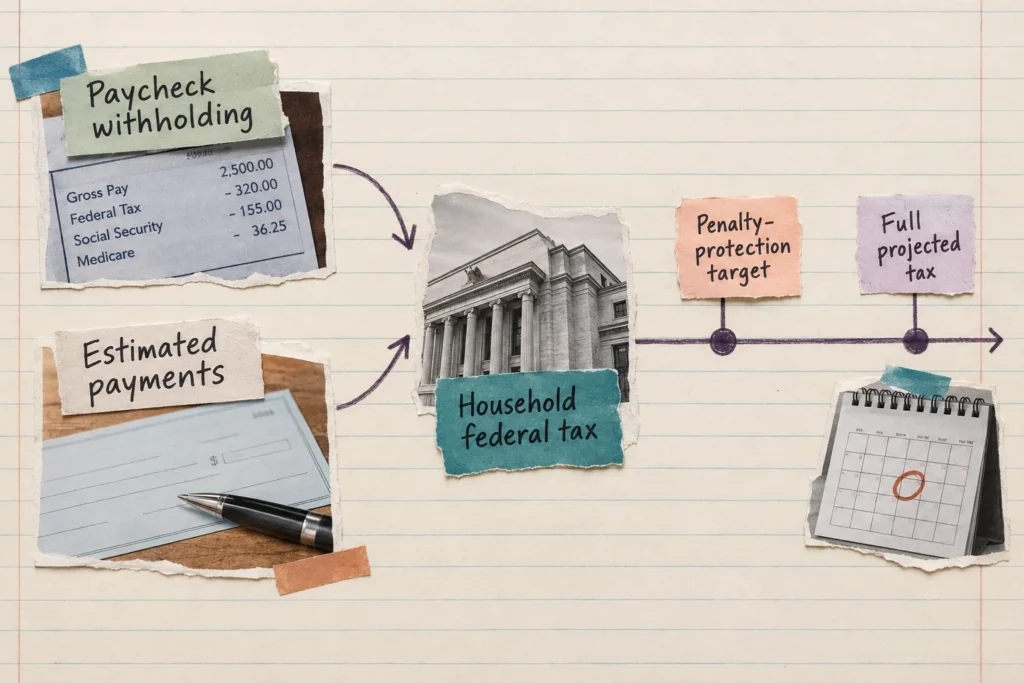
Under the ordinary federal test, you generally need estimated payments if you expect to owe at least $1,000 after withholding and refundable credits, and your withholding and refundable credits will be below the applicable protection threshold. You can eliminate the need to make estimated payments by increasing your withholding enough. The general protection threshold is the smaller of:[1]
- 90% of your 2026 estimated tax, calculated using the rules in the worksheet.
- 100% of your 2025 tax, or 110% if your 2025 adjusted gross income exceeded $150,000 ($75,000 if married filing separately in 2026).
These thresholds are often referred to as safe harbors. The prior-year return must cover 12 months, and the tax shown on that return isn’t your balance due or refund. The safe harbor rules can also be used if you had no 2025 tax liability, were a US citizen or resident alien throughout 2025 and that tax year covered 12 months.[1]
I like the prior-year option because it can give you a firm payment target while this year's profit is uncertain. What I don't like is calling that target your tax bill. Meeting it can protect you from an underpayment penalty while leaving thousands of dollars due at filing. Timing still matters, too.[1][2]
What the gap means for your paycheck
Here's a hypothetical household, not a calculated tax return. Its projected 2026 federal tax is $14,500, expected full-year withholding is $10,200, and worksheet-defined 2025 tax is $12,000. Assume it qualifies for the 100% prior-year rule, has no complicating credits or estimated payments already made, and has eight paychecks left in October, all payable by December 31. Since 90% × $14,500 = $13,050, its smaller protection target is $12,000.[1]
| Goal | Additional payment needed | Extra withholding over 8 paychecks | Projected balance at filing |
|---|---|---|---|
| Reach $12,000 penalty-protection target | $12,000, $10,200 = $1,800 | $225 per paycheck | $2,500 |
| Cover full $14,500 projected tax | $14,500, $10,200 = $4,300 | $537.50 per paycheck | $0 |
For the payroll route, additional withholding goes in Form W-4 Step 4(c) as a dollar amount per pay period. Don’t put self-employment income in Step 4a. the instructions say to use the estimator for that situation. These figures assume your withholding remains the same and payroll processes your eight adjustments. If Step 4(c) already has an amount, include it in the calculation rather than accidentally replacing withholding you're counting on.[3][4]
Since your situation sounds stable, and smaller paychecks work with your budget, I would lean toward withholding. You'll have one less pay schedule to manage. Estimated payments would be the other option if your payroll can't process an increase in time, your job is ending, or your wages can't support the increase. Neither option puts more money in your pocket. The question would be how do you make the payment, not whether you have the money to make the payment.
October withholding and an October payment aren't equivalent
For the average calendar year taxpayer, the 2026 estimated payment due dates are April 15, June 15, September 15, and January 15, 2027. Had our household planned from the beginning, four timely $450 estimated payments would close its $1,800 protection gap under the regular installment method, with its withholding allocated evenly across the year.[1][2]
Here's the useful difference: federal withholding is generally treated as paid one-fourth on each installment date, even when more was withheld late in the year. An additional $1,800 actually withheld from October through December brings this household's default allocation to $3,000 per installment, matching its $12,000 annual protection target.[2][5]
A $1,800 estimated payment in October counts on its actual payment date; it doesn't erase earlier late-payment periods. Same annual total, different timing. That's why I wouldn't simply divide an October shortfall by the remaining estimated-payment deadlines. An election to use actual withholding dates can change the treatment, and a payroll catch-up for 2026 must actually be withheld during 2026, a January 2027 paycheck is too late.[2][5]
When the simple calculation needs more work
Annualized income installment method assumes the majority of the profit arrives at the end of the year. Therefore, it may reduce what was required earlier. Annualized income installment method uses the cumulative periods ending March 31, May 31, August 31, and December 31. You will need period specific income and deduction records and Form 2210 with Schedule AI when filing. This is not simply paying a percentage of each quarter's sales.[1][2]
When you're not sure of the outcome of some of the preceding aspects of the projection such as " if stock compensation is realized this year and what type of capital gains/losses I realized?" I would consult a CPA or enrolled agent to calculate the affected tax or installments. I would also consult a professional to determine if my business activity is a hobby and other uncertain aspects like changing my filing status, selling my personal residence, and/or claiming certain credits.
Bring dated profit and loss statements, recent paystubs, prior-year tax return and payment confirmations. A calculator can’t help answer an uncertain expense classification or missing payment dates.[1][2][4]
Check state payments separately. California, for instance, uses a $500 threshold ($250 for married/RDP filing separately) and installment shares of 30%, 40%, 0%, and 30%. The state withholding adjustment uses Form DE 4, not a federal W-4. Your federal plan, therefore, isn't automatically your state plan. There can also be special rules for taxpayers and applicable disaster relief that will also alter the standard federal schedule.[1][6]
After changing withholding, check the first affected paystub to confirm your calculation. Recalculate before the next estimated-payment deadline, sooner if your profit or employment changes, and again in January to catch up on a shortfall to reduce the risk that next year's checks will be smaller. Keep the projected filing balance next to the payment. That $2,500 in our example hasn't disappeared just because the penalty problem is handled.[1][4]
Sources and references
- Internal Revenue Service: 2026 Form 1040-ES
- Internal Revenue Service: Publication 505 (2026), Tax Withholding and Estimated Tax
- Internal Revenue Service: 2026 Form W-4 and instructions
- Internal Revenue Service: Tax Withholding Estimator
- Internal Revenue Service: Instructions for Form 2210 (2025)
- California Franchise Tax Board: 2026 Instructions for Form 540-ES
