


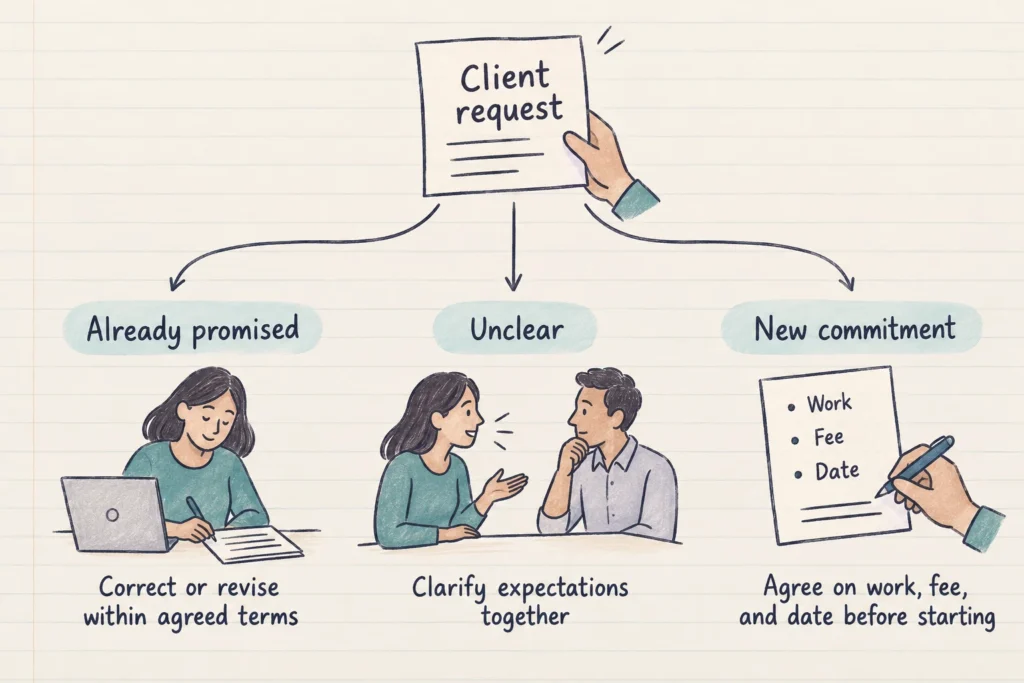
Honor what you already promised, then negotiate anything genuinely new before doing it. Fix your mistakes and complete included revisions within the existing fee. If the request goes beyond that promise, offer a paid addition, a swap for unfinished work, or separately scheduled paid delivery. You don’t have to choose between an automatic yes and a chilly refusal.
I wouldn’t open by accusing a good client of scope creep. They may see a useful improvement without seeing the evening it will consume. Make that tradeoff visible and give them something concrete to approve. That keeps the conversation cooperative, though no script can promise you’ll keep the client.
Start with the promise, not how long the request takes
Go through your existing agreements, messages, and approvals. What did you agree to do, what format was it to be delivered in, what is it for, how many revisions will you do, and when is it to be done? A clarification fills in a missing detail, and a correction or change brings your work into compliance with your agreement. An addition is work that goes beyond the agreement.
A mistake in something you copied is a debt owed. Changing a chart to what you think it should be may be an included revision. A handout is likely an addition. Making an existing chart what you think it should be is a change you owe. And if it takes longer to create the presentation deck than you estimated, that’s your problem.
Revision limits are very helpful and the template from the Freelancers' Union contains default settings for revision counts and charges, request and completion periods, and (more) revision charges. I would not use an exhausted allowance to charge for work that is not yet done. I wouldn't use an allowance to charge for my failure to meet the requirements of a job.
Including a correction, a simple "You're right" is all that's required. "I'll correct it within the existing fee and send the updated deck on Thursday." There's nothing else to discuss.
Ambiguities are subject to interpretation, and I'm willing to discuss, although I generally prefer to acknowledge my role in an ambiguous proposal and revise the agreement. "I read 'presentation materials' as the deck and speaker's notes, but I guess you read it as something else. Was a hard copy handout what you expected?"
I don't just design decks, I interpret. I prefer to review the agreement and settle format, content, review allowance, and fee (if any) and time of delivery.
A small request can consume two more evenings
Picture me in a hypothetical deck project, reading “Could you just make a one-page handout?” while my dinner cools beside the laptop. I’m tempted to say yes: the content already exists. Then I notice the handout needs a new layout and its own review. I’m irritated with that little word “just,” but instead of sending a sharp reply, I count the work and offer choices.
Keep that hypothetical project: a $900 fee, $60 in project cash costs, and 18 total business hours, including selling, coordination, production, and the agreed revisions. The handout adds 30 minutes to confirm content, 90 minutes to condense and lay it out, 30 minutes for review changes, and 30 minutes for export checks and delivery. That’s three hours, not merely the time spent moving text boxes.
| Project | Fee minus cash costs | Total business hours | Contribution per hour |
|---|---|---|---|
| Original commitment | $900, $60 = $840 | 18 | $840 ÷ 18 = $46.67 |
| Handout absorbed for free | $900, $60 = $840 | 21 | $840 ÷ 21 = $40.00 |
| Handout added for $140 | $1,040, $60 = $980 | 21 | $980 ÷ 21 = $46.67 |
This is contribution per total business hour, not take-home pay: taxes and any overhead outside the $60 still matter. The $140 addition preserves the example’s original hourly figure; it isn’t a market-rate recommendation. If extra costs or review time change, redo the calculation.
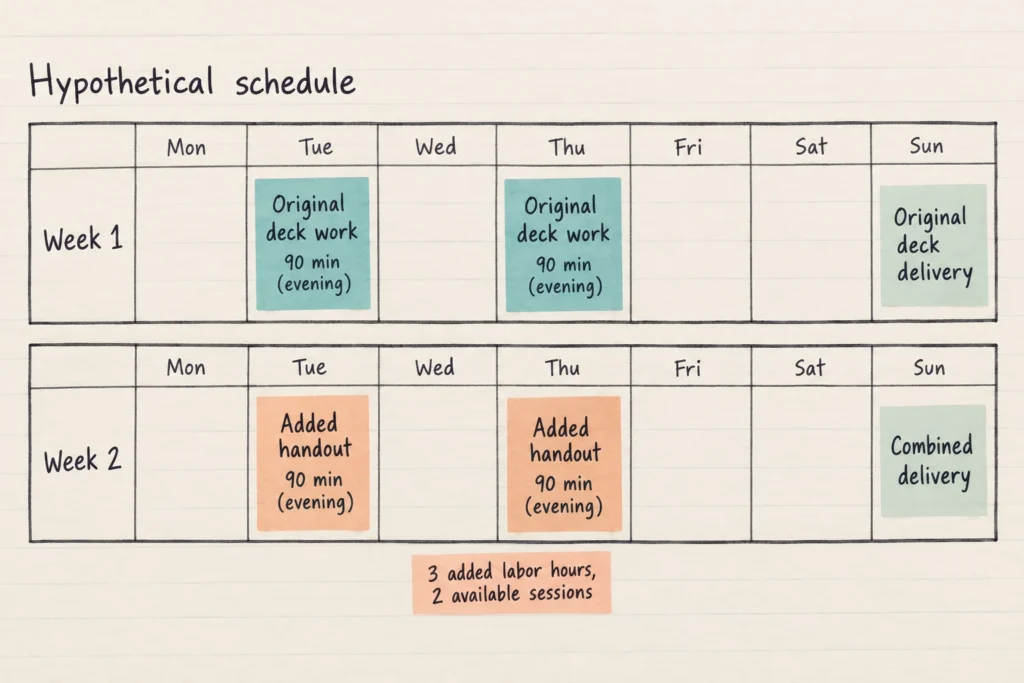
Hours and delivery dates are different things. Suppose your remaining original work occupies this Tuesday and Thursday’s 90-minute evening sessions. The next two available sessions are next Tuesday and Thursday. Adding the handout shifts combined delivery by a week, even though it adds only three labor hours. Quote the date your actual calendar supports, including time for client input, not a three-hour delay you can’t deliver.
Give the client a choice you can afford
A paid addition works when the client wants more and you have capacity. A swap works when they value the new item more than something unfinished. I’d compare hours, not item counts: three hours of unstarted speaker notes could fund this handout, but deleting notes you’ve already completed won’t give those hours back. The swap also needs to fit the remaining calendar, including client review.
Scheduled payments let you finish the deck on time and do the handout later. Moving the date doesn’t pay for the labor. If the addition requires expertise you don’t have or would displace another commitment, turn down that request. “I can finish the agreed-upon deck this Thursday but can’t take on the handout for your event.” You aren’t terminating the relationship, you’re not taking on the work.
Be generous deliberately, not by default
I am ok with a small concession if the cost is affordable, the client is worth keeping, and it won’t displace another commitment. But be aware of how many times you’re doing this. A 20 minute adjustment may be reasonable, but several small requests can significantly cut into what you think is available.
Make exceptions clear: “I’ll do this small exception for free this time. Other exceptions and requests remain at the regular rate.” An owed correction is not goodwill. And if you’ve silently done additional work, don’t agree to a surprise charge. Tell the client what’s happening and make a request for the work you’re doing to remain in your boundaries.
Make the revised promise easy to approve
Less paperwork is needed for a smaller addition. According to AIGA, a change order is a “mini-proposal” for extra time and money, related to the original proposal. The Freelancers Union template for a change order requires both parties to agree to the changes in writing. I’d keep the confirmation short, but leave no doubt about what you’re now promising.
Take a look at your existing agreement to see what the format is for approval, and who is authorized to approve changes. A friendly request from someone who can’t approve the change is not approval. According to the ASCE, the authorized approver and the person requesting the change should be separated, and changes in scope, schedule and fee should be documented. Use a signed change order if your agreement requires one; don’t assume a message is an approval. These examples do not constitute legal advice.
Sources and references
- AIGA: Standard Form of Agreement for Design Services, 2022 update
- Freelancers Union: Contract Creator
- American Society of Civil Engineers: Claim Reduction: Addressing changes in scope, schedule, and budget (2026-05-04)
