

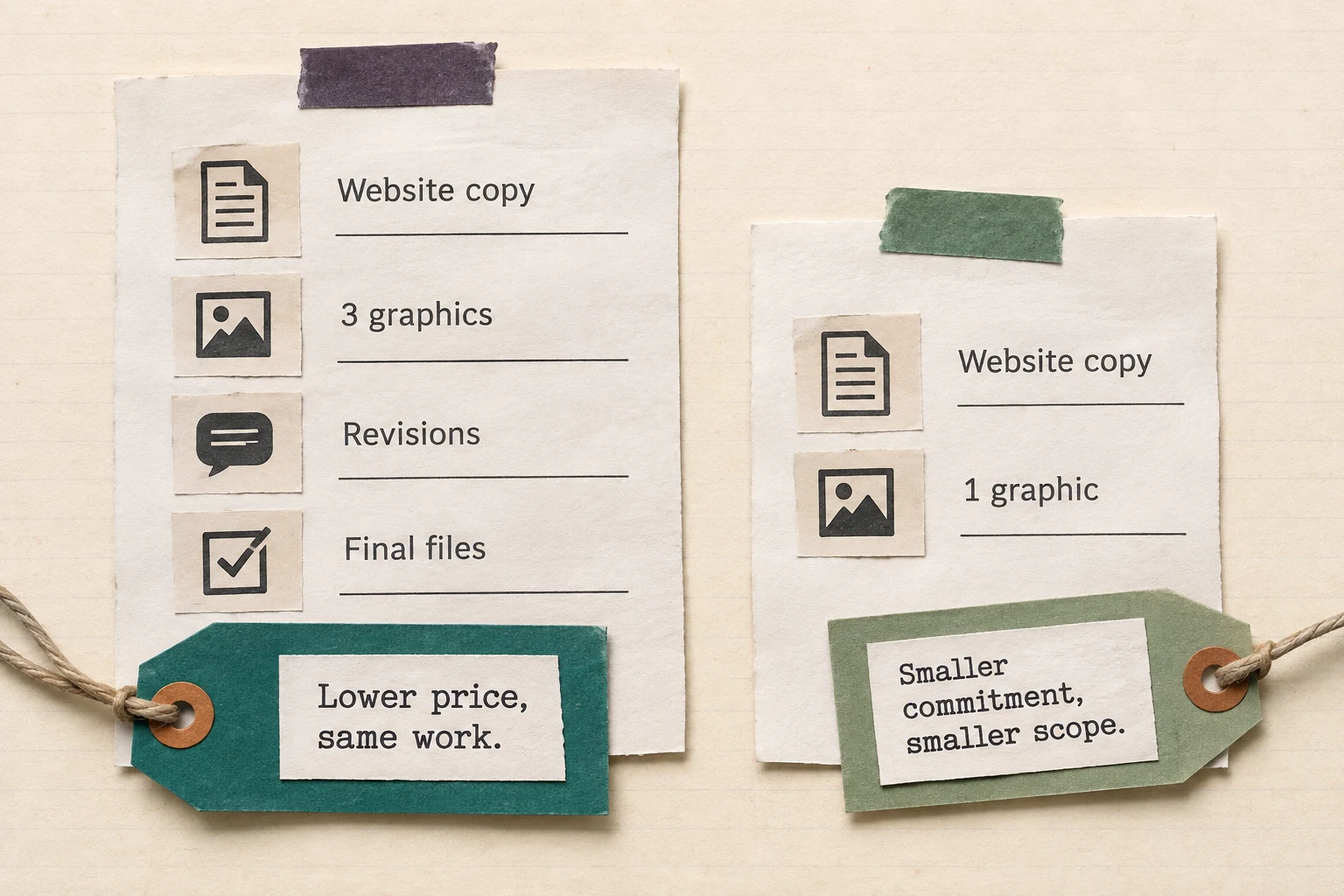
Discounting your services can be a good way to gain your first few clients. If you’ve budgeted for it and the job is scope-defined, then I’d say it’s worthwhile. Discounting your services won’t necessarily get you the job, though. If you don’t think your price is negotiable, I’d suggest comparing the concession to a smaller paid job: you may be able to get the buyer to commit to less in order to get the result they want.
What would a lower price actually fix?
When you’re asking why the client hasn’t purchased, you can ask “Is the obstacle the total budget? Is it uncertainty with the result? Is it getting this approved?" There are also other reasons, like "I want to get a better price," but that will take additional work, and that's a risk for you if the client doesn't buy the result.
Imagine I’m drafting a proposal after dinner, with an unfinished sample open in another tab. The buyer says an entire website rewrite feels like too much to approve. I’m tempted to knock $200 off just to get a yes, and annoyed that another evening might produce nothing. Instead, I offer one paid service-page rewrite. Their hesitation was about the size of the commitment, not necessarily my price.
A bounded discount makes sense if the buyer has a real budget gap and has a general understanding of your work. A sample or smaller paid deliverable would more directly address the buyer’s doubts about your ability. A cheaper version may still not be something they need. I wouldn’t make a concession based on your testimonial section being empty.
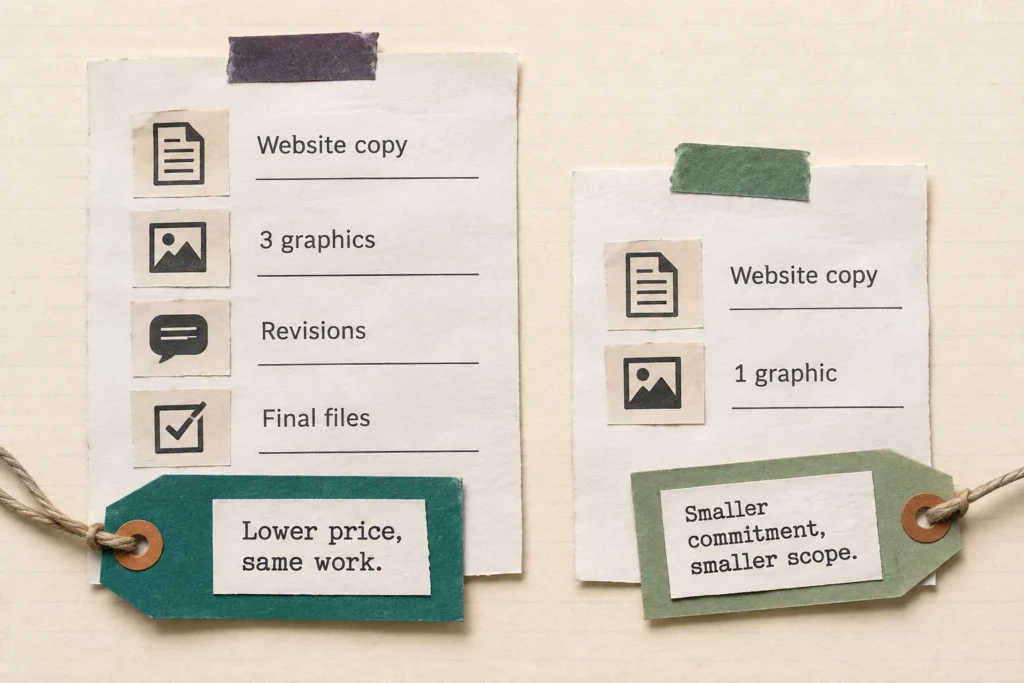
I have my doubts about the absolute statement that lower price equals poor quality. One older meta-analysis found the relationship between price and quality to be contextual and especially weak for services and more familiar products. The suggestion here is to question the absolute statement, not a prediction that a discount would result in winning appropriate clients or repeat work.[1]
A smaller invoice doesn’t have to mean cheaper labor
Here’s a hypothetical situation you can adjust to your situation. A standard package and smaller project both price production time at $100/hour, but you don’t get to keep $100 for every hour worked. Time is consumed by other activities like selling and administering your business. The expenses below are assumed to cover the costs of doing business for each option. These are not actual results for a freelancer.
| Cost or time | Standard package | Same package, discounted | Smaller paid project |
|---|---|---|---|
| Collected fee | $800 | $600 | $300 |
| Sales and prospecting | 4 hours | 4 hours | 2 hours |
| Production | 8 hours | 8 hours | 3 hours |
| Revisions | 2 hours | 2 hours | 1 hour |
| Administration | 1 hour | 1 hour | 1 hour |
| Total business time | 15 hours | 15 hours | 7 hours |
| Business expenses | $40 | $40 | $20 |
| Fee minus expenses | $760 | $560 | $280 |
| Pretax earnings per business hour | $50.67 | $37.33 | $40.00 |
The smaller project gives the buyer something independently useful, not a piece of an incomplete project they must purchase more of to finish. The smaller project allows the buyer a lower commitment at $300 instead of the full $800 commitment. The smaller project has lower all-in earnings compared to the standard package because a larger portion of the time is spent on sales and administration. Smaller is not always more efficient.
When developing your estimate consider only failed outreach that is attributable to this initial test. Spread the time spent on shared prospecting across the projects but do not count that time twice. A booked appointment doesn't erase the time spent finding it.
Put a dollar limit on the concession
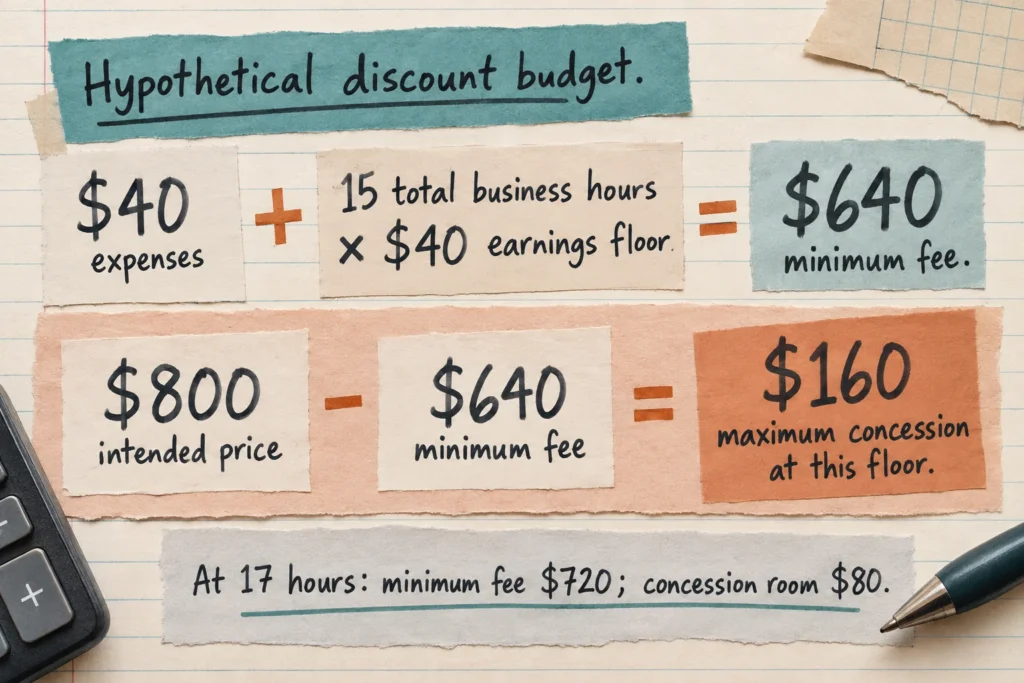
Suppose $40 per business hour is the minimum you want this work to earn. For the 15-hour package, your minimum fee is $40 in expenses + (15 × $40), or $640. Against the intended $800 price, that leaves room for a $160 concession, not $200, if you want to meet that floor.
At $600, three things are true. The first is that there is a $200 nominal discount. The second is that after expenses are accounted for, the project has a surplus of $560. Finally, there is a gap of $40 against an earnings floor. These three things are true for a single project. The $200 nominal discount is not proven lost revenue if the buyer is not willing to pay $800.
You could choose to see the $40 as a positive shortfall learning opportunity. I’d call it a learning or acquisition allowance. I would not try to claim the work met your target. Compensation should be at an acceptable level for your evening’s work. Don’t include a dollar value to your sale hours, as they are already included in your earnings.
Revisions are the assumption I’d stress-test first. Two extra hours bring the discounted project to 17 hours, dropping earnings to $32.94/hour. Meeting the $40 floor requires another $720 worth of work. At that workload, you would only have $80 of the weekend available. If it swallows your available weekend, change the scope or keep the original offer.
The price ends; the agreed project doesn’t
I would put that line in the proposal, rather than leave you explaining it to the client when the client requests another project. You must also name who qualifies, the due date, deliverables, the delivery window, and the price of doing the work later. The Freelancers Union tool also covers some of these, such as payment terms, revision limits, feedback window, and changes to the work. While they may help in coming to an agreement, not all provisions will be enforced where you work.[2]
Use dates and quantities you can actually honor. Once someone accepts, honor that agreed fee; the expiry closes the offer to new acceptances, not to an existing client halfway through delivery. Showing the standard price clarifies the next purchase, but it doesn’t prove anyone will pay it.
What would make this discount worth repeating?
You may want to name the thing you don’t yet know. How long will delivery take? What does this buyer really need? Are you able to provide a sample? Once it’s produced, offer it to the client. Track the time, costs, and revisions to evaluate the project against your prediction. Results may take longer to observe or even be outside your control. I wouldn’t budget around expected future results.
If providing a portfolio sample is the reason you are accepting less, come to an agreement about what you can publish and when before you settle on the price. Freelancers Union’s template for creative work says that to define the freelancer’s intended use, the agreement, any obligations of confidentiality, and the rights of third parties control what the freelancer can publish. Just because you pay for a sample, that does not mean you can publish it. Similarly, just because feedback is given to you privately, that does not mean you are allowed to publish it.[3]
Separate concessions from promises of praise. The FTC says that rewarding or punishing a consumer for leaving a review is an unfair act or practice. A discount offered for an endorsement or review may require a disclosure and the review platform may prohibit the offering of incentives for honest reviews.[4][5]
I’d repeat the discount only if the first project stayed within your allowance, delivered the planned learning, and another discounted project would answer something still unresolved. If you now need to know whether buyers will pay your intended regular price, ask for a paid project at that price. Don’t assume the first client will make that transition. One full-price sale still won’t prove you have a repeatable way to find clients, but more discounted bookings won’t answer the price question at all.
Sources and references
- Marketing Letters / Springer Nature: The price-perceived quality relationship: A meta-analytic review and assessment of its determinants (2007-03-13)
- Freelancers Union: Contract Creator
- Freelancers Union: Design, Photo, and/or Video Limited Use Contract Template
- Federal Trade Commission: The Consumer Reviews and Testimonials Rule: Questions and Answers
- Federal Trade Commission: FTC's Endorsement Guides: What People Are Asking
