


People can genuinely like your offer without wanting to buy it on your terms. A compliment doesn’t tell you whether they need it now, prefer it to their current alternative, control the money, or trust you enough to pay. Before lowering the price or spending on promotion, find out who praised it, what they actually saw, and whether they faced a real purchasing choice.
I wouldn’t dismiss the praise. But I also wouldn’t let it authorize another weekend of building. “That’s a great idea” answers a much easier question than “Will I spend $180 on this instead of something else?” Your job is to investigate the distance between those answers, not argue someone across it.
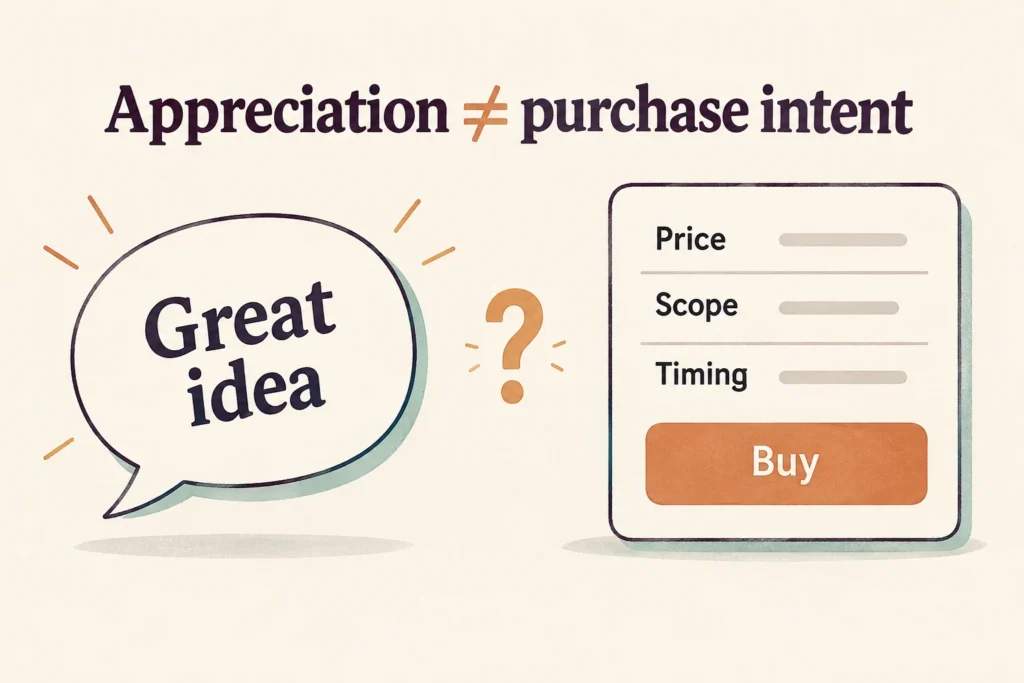
Praise leaves the expensive questions unanswered
There are multiple reasons why someone might acknowledge your idea. The idea may have merit, the need may exist, but the solution may not be needed now. What if the solution is a gift, and the occasion is not for some time? In order for a purchase to happen, a person needs to have a reason to choose it over all other alternatives.
Research gives us a reason to distinguish words from payment. Schmidt and Bijmolt’s meta-analysis of consumer-goods studies found that hypothetical willingness to pay tended to exceed willingness to pay when payment was consequential. That doesn’t mean your admirers are lying, and it provides no formula for converting compliments into sales. It means imagining a purchase and committing money are different tasks.[1]
First, evaluate if people saw your price, your offer’s exact scope, when and how they could expect delivery, and your buying route. If they only heard “I’m offering newsletter help,” you don’t know what their response is to a $180 setup service. No exposure is not a rejection, and silence before you show your price isn’t a price objection.
Who liked it, and who can buy it?
Picture me, in an imagined example, spending a Tuesday evening polishing a $180 newsletter setup offer after a shop employee says, “We could really use that.” Then I learn she handles the emails but can’t approve outside spending. I’m annoyed at the evening I’ve already spent formatting the proposal. Instead of adding features, I ask whether she’d be comfortable introducing me to the owner.
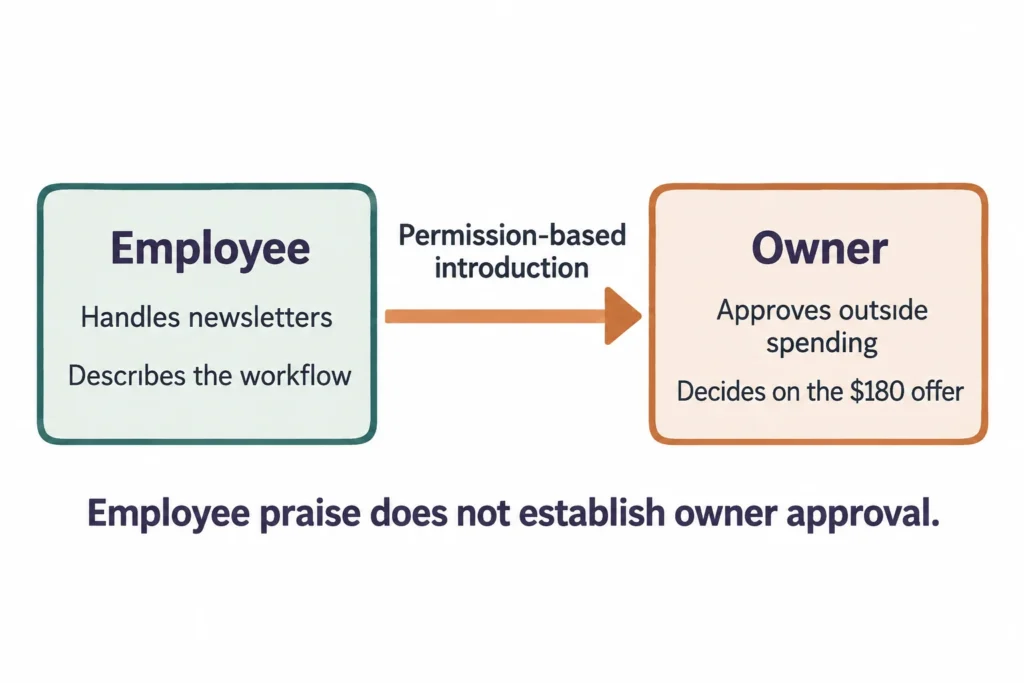
That distinction is more valuable than if the person is a friend or stranger. A friend can be a qualified buyer. A follower can be outside your market. A user can describe the problem perfectly while someone else controls the purse strings. Who you recruit matters. Relevant recruitment is more valuable than who the people are that are related to the recruitment.[3]
Ask for a story, not another vote of confidence
I’d open with asking for permission to ask questions: “I really appreciate the feedback. Can I ask how you handle this now? It’s okay if this isn’t something you would purchase?” After that I would listen to what they say. The recommendation is to ask questions related to the person’s experience. What isn’t actually asked is often agreed to. So “Wouldn’t this save you loads of time” is a good starting place.[2][4]
- “Walk me through the last newsletter you sent. Which part took the most work?”
- “How do you handle that today? Have you paid for help or tools?”
- Consequences and urgency: “What happens when it gets delayed? Is there anything coming up that changes when you’d address it?”
- “What happens if it gets delayed?”
“How did you get approval for the last outside service you paid for?”
- “What made you turn down the offer?” If the answer is unclear, “What did you do instead?”
These questions help draw constraints. If someone says “It’s too expensive,” ask “Compared to what?” instead of offering a discount. A bill for $180 might be excessive when there’s a free solution. Or they might think the service is risky because the deliverables are unclear. These all require different changes.
| Possible constraint | Clue to investigate | Useful next move |
|---|---|---|
| Buyer fit or authority | They experience the problem but don’t purchase solutions. | Ask for a permission-based introduction to the buyer. |
| Timing or priority | The current workaround is acceptable, or a buying occasion hasn’t arrived. | Learn the purchase trigger; don’t manufacture urgency. |
| Budget or relative value | They name an actual spending limit or a preferred alternative. | Consider viable narrower scope, or accept that this buyer isn’t a fit. |
| Trust or delivery uncertainty | They hesitate over the result, handoff, access, or paying before delivery. | Clarify deliverables or offer a bounded pilot you can fulfill. |
The $180 offer for the newsletter is still on the table until the terms are revealed. “For $180, I'll create a reusable template within your email tool with one revision and deliver it in 7 days. Would you like to book it?” Acceptance tests offer. A request to create only the template tests different scope if it's something you're able to provide. A refusal is a refusal, it's not an invitation to keep trying to convince them.
A commitment is stronger evidence, but evidence of what?
While prone to echo chambers, deposits and preorders are more trustworthy indicators than praise. Fully refundable deposits don’t discourage cancellations. Refusing to preorder may be delivery risk aversion, not dislike. If payment in advance to receive your product isn’t normal for your buyer, a small deliverable paid for on completion may be more helpful.
Prior to receiving payment, state what the buyer will receive, the total price, when and how the product will be delivered, your terms for cancellations, refunds, and/or deposits, and how and when refunds will be made. Keep cash or other funds available to cover your obligations. Payment is a customer obligation, not just a sales enabler.
Count purchasing opportunities, not encouraging reactions
State who saw your offer and what their experience and buying ability is. Note where you found them and what, if anything, happened next. Keep payment and delivery separate, and record refunds. Easier said than done, but keeping records this way will protect you from saying deposits are more convincing than they really are, because you’ve forgotten all the people who didn’t make a deposit.
A few casual conversations don’t count as market conversion estimates. Recruitment bias is a thing and people’s accounts may reflect imperfect memories or attempts to please you. Look for recurring patterns, then validate your strongest hypothesis with a true choice. Don’t treat five versions of “sounds great” as five independent reasons to buy equipment.[3][4]
I'd spend the next one unanswered purchasing question, not the other feature. If the wrong people praised it, talk to buyers. If you think delivery feels risky, either clarify or lower the commitment. If the people who are in the best position to evaluate the offer, understand the terms and continue to choose the competitive offer over yours, consider pausing. You're not always wrong to continue investing in the offer, especially if no one’s buying, but you’re probably wrong to continue investing with only general encouragement as your justification.
Sources and references
- Journal of the Academy of Marketing Science / Springer Nature: Schmidt and Bijmolt, hypothetical willingness-to-pay meta-analysis (2019-06-07)
- Government Digital Service: Using in-depth interviews (2017-02-21)
- Government Digital Service: Finding participants for user research (2016-03-01)
- Nielsen Norman Group: User Interviews 101
- Federal Trade Commission: Business Guide to the FTC's Mail, Internet, or Telephone Order Merchandise Rule
