

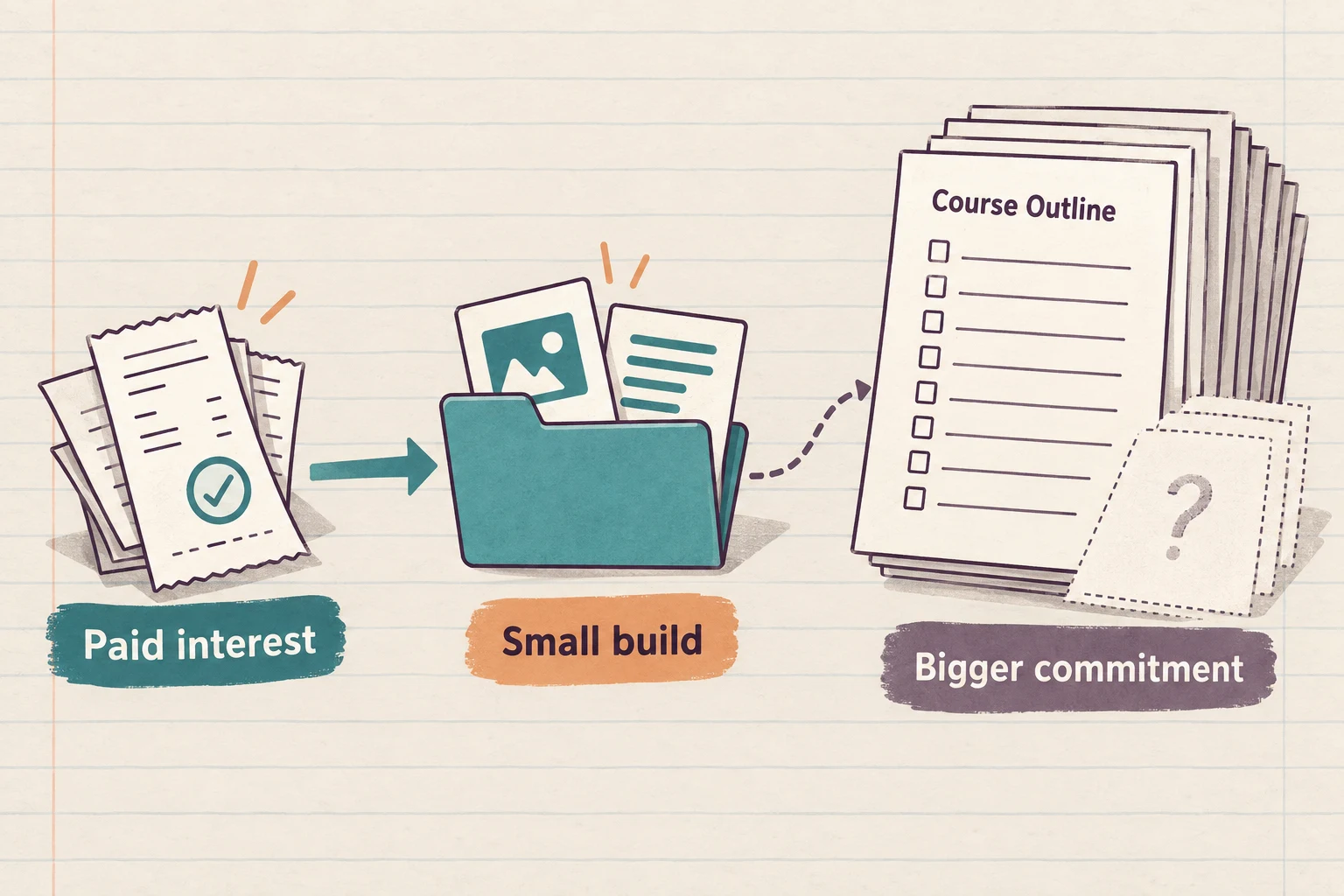
You don’t need a fixed number of sales before building a digital product. You need payment evidence strong enough to justify the particular amount of time and money you’re about to commit, and a plausible way to reach the buyers who will repay that investment. Three purchases might justify a tiny toolkit. Thirty might still leave a large course looking expensive.
I’d separate two numbers: the sales your forecast says you need, and the purchases you’ve actually observed. The first is arithmetic. The second is evidence about a particular offer, price, audience, and sales channel. Neither tells you, by itself, that dependable income is coming.
What would this build have to earn back?
The SBA’s break-even analysis calculates fixed costs and divides it by the sale price, minus variable costs. For a side hustle, I would include an estimate of your time. Your time has value just because you aren’t charging for it.[1]
Let’s say you want to sell a $49 toolkit and want to recover your investment in 90 days. These are estimates, not measurable data. Let’s say your time is worth $25 an hour and you exclude collected sales tax. Also pretend you are doing the analysis before the toolkit is sold.
- Build: 40 hours x $25 = $1,000.
- Launch and setup costs: 8 hours x $25 = $200 (separate from buyer acquisition).
- Fixed costs: $120. Total Investment: $1,320.
- Per Sale: allow $4 for payment/platform costs and expected refunds, $5 for 12 minutes of support, and $10 for 24 minutes of acquisition.
- Contribution per sale: $49, $4, $5, $10 = $30.
You’d need $1,320 ÷ $30 = 44 sales to recover that investment. This is an owner-time-adjusted planning target. It is neither accounting profit nor a guarantee. Use your actual fees and refund experience where you can. The $4 allowance is not a quoted rate by a provider. If contribution is negative or zero, then you will never recover your fixed cost.[1]
Acquisition time is where I would be the least likely to accept a 'cheerful guess'. You would need to spend 17.6 hours doing acquisition work to sell to the 44 people in order to make your investment back. If it takes 48 minutes per buyer, your contribution falls to $20, and you would need to sell 66 people instead. That's 52.8 hours of work acquiring people who want to buy. That does not include the work it takes to build and launch your product or service, or support it after the launch. Paid advertising adds another cost if you haven't already included it in your planning.
Your first buyers don’t locate the rest
Now suppose eight of 80 prospects bought the offer at $49. That means your purchase rate is 10%. Against the 44-sale target, you need 36 more purchases; extending the same rate would require 360 additional comparable prospects. Again, this is not 360 people you have demonstrated you can reach.
Picture me, in an imagined example, opening eight purchase notifications after dinner and immediately blocking out four weekends to build. Then I notice that most buyers know me personally, while my launch plan says “search traffic.” My excitement loses a little altitude. I leave the weekends unbooked and test the offer with unfamiliar buyers instead.
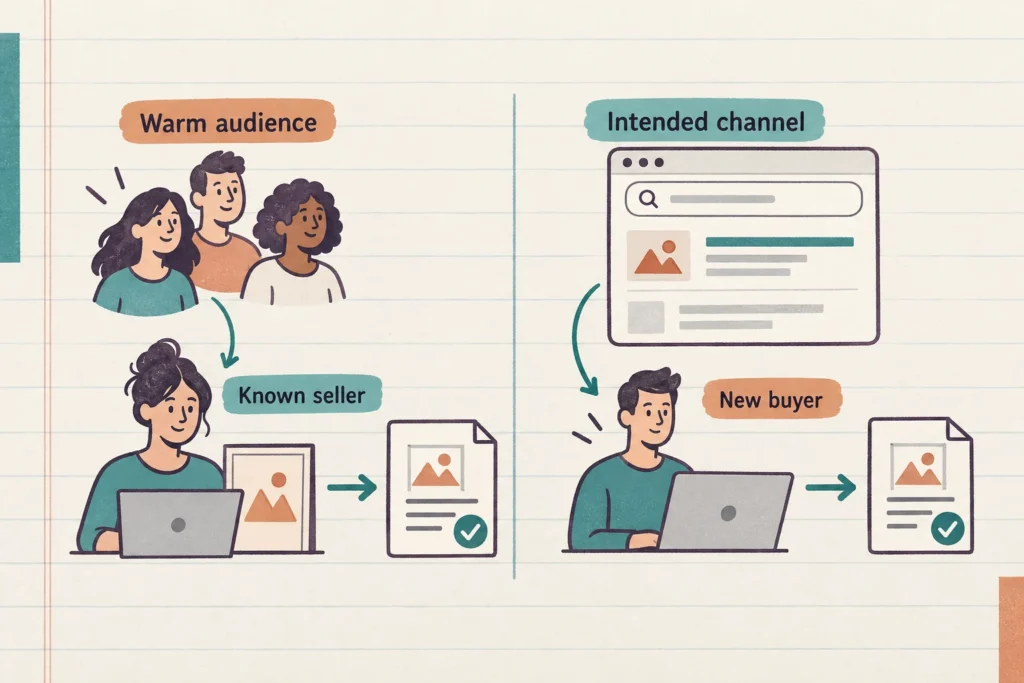
People buying is actual revenue, but friends may just be doing you a favor and aren’t the best gauge of what the market will bear. In the case where a genuine audience remains, how many people can you actually put your offer in front of, at your price point, within your acquisition budget and within 90 days?
Eight purchases from an intended audience, through the channel you plan to utilize, says a lot more about that plan than eight heavily discounted purchases from supportive friends. Friend buy-ins still leave a lot of questions. Further sales from the same warm audience still don’t answer whether cold audiences will buy. A test at $49 isn’t a demand test.
What did the buyer actually commit to?
Payment is better because there’s less of a psychological barrier to saying no than there is to purchasing. A peer reviewed meta analysis of consumer good studies found people’s stated willingness to pay often exceeded their real willingness to pay. People are often quick to answer “yes” to survey questions but that doesn’t always translate to the real world. You can’t always adjust your price to account for your waitlist.[2]
| Evidence | What it tells you | What remains unresolved |
|---|---|---|
| Interview | How someone describes the problem and current alternatives. | Whether they’ll pay your price. |
| Waitlist signup | Someone wants to hear more. | Whether they’ll purchase when asked. |
| Paid pilot | Someone pays for the promised outcome; delivery can reveal useful problems. | Whether they want the reusable product without your personal help. You owe the pilot’s promised delivery. |
| Deposit | Someone commits money under the stated terms. | Whether they’ll pay the balance. You owe the agreed reservation, delivery, or refund conditions. |
| Full-price preorder | Someone pays the intended price for a clearly described future product. | Whether you can fulfill it, whether they’ll keep it, and whether more buyers are reachable. |
I like a paid pilot to test whether a product is helpful to people. Your product may not be a good fit to sell digitally if it’s mainly people buying your time to give them one-on-one instruction. A test of your expensive uncertainty shouldn’t always be the one that gets the most buyers.
A preorder isn’t money you can freely lose
If you can’t yet describe a deliverable you can plausibly finish by a stated date, don’t take full-price preorders for it. Offer a narrower pilot you can deliver now, or keep collecting nonpayment evidence. US advertising guidance requires truthful, nondeceptive claims and clear disclosures; unfinished status, scope, availability, and any minimum-order condition belong where buyers can see them before paying.[5]
The refund promise depends on what you sell and how buyers pay. Teachable’s terms, for example, generally give native-gateway course buyers a 14-day refund entitlement from purchase. For digital downloads, creators set the refund policy and disclose it before purchase; custom gateways and approved arrangements can differ. These are platform terms, not a universal US cancellation period, and applicable law can impose other obligations. The FTC merchandise rule excludes services, so its shipping deadlines aren’t a shortcut for deciding the rules for every course or download. It doesn’t settle every download’s classification.[4][6]
I wouldn’t treat preorder receipts as spare build money. Eight $49 preorders mean $392 you may need to return, with enough of your own cash available to cover fees that aren’t recovered. Stripe draws refunds from the available balance, can leave card refunds pending when that balance is insufficient, and doesn’t return original processing fees. Keep the cash to unwind the presale: the forecast’s expected-refund allowance won’t cover refunding everyone if delivery fails.[3]
Let the evidence buy a smaller commitment
Say your affordable-loss limit is $200 of your own cash and 12 hours, with refundable customer money kept separate. The 48-hour build-and-launch commitment exceeds that limit, though the $120 cash cost of the build fits within it. Eight purchases won't remove the time constraint.
I’d price and scope a separate pilot that fits your $200 and 12 hour limits, accounting for both acquisition and delivery time. Then, I’d test it through the channel you expect to keep using. If you’ve taken and filled preorders for the main product, you can’t simply replace it with the pilot: you have to deliver what you’ve promised, and/or get your buyers to agree to the new, modified offer, and/or unwind the deal under the terms disclosed.[5]
Eight purchases can be evidence of a dependable income stream, and justify the production of a small item. The proof of a route to the remaining buyers at the price and acquisition cost that repays the outlay within your time horizon would change my mind about the larger build. Until then, those four weekends will remain yours.
Sources and references
- U.S. Small Business Administration: Break-even point
- Journal of the Academy of Marketing Science; Jonas Schmidt and Tammo H. A. Bijmolt: Accurately measuring willingness to pay for consumer goods: a meta-analysis of the hypothetical bias (2019-06-07)
- Stripe: Refund and cancel payments
- Teachable: Terms of Use, Section 14.2 (2026-04-20)
- Federal Trade Commission: Advertising FAQ's: A Guide for Small Business
- Federal Trade Commission: Business Guide to the FTC's Mail, Internet, or Telephone Order Merchandise Rule
