


Hiring help makes sense when a repeatable task can leave your desk without lowering quality, the handoff genuinely reduces your workload, and enough income remains to meet your needs. Being busy isn’t enough. I’d rather see you buy back an evening deliberately than pay someone to create a second inbox you have to supervise.
The distinction matters: delegation can improve what you earn per owner hour while reducing your total earnings. That can be worthwhile relief. It just isn’t automatically growth.
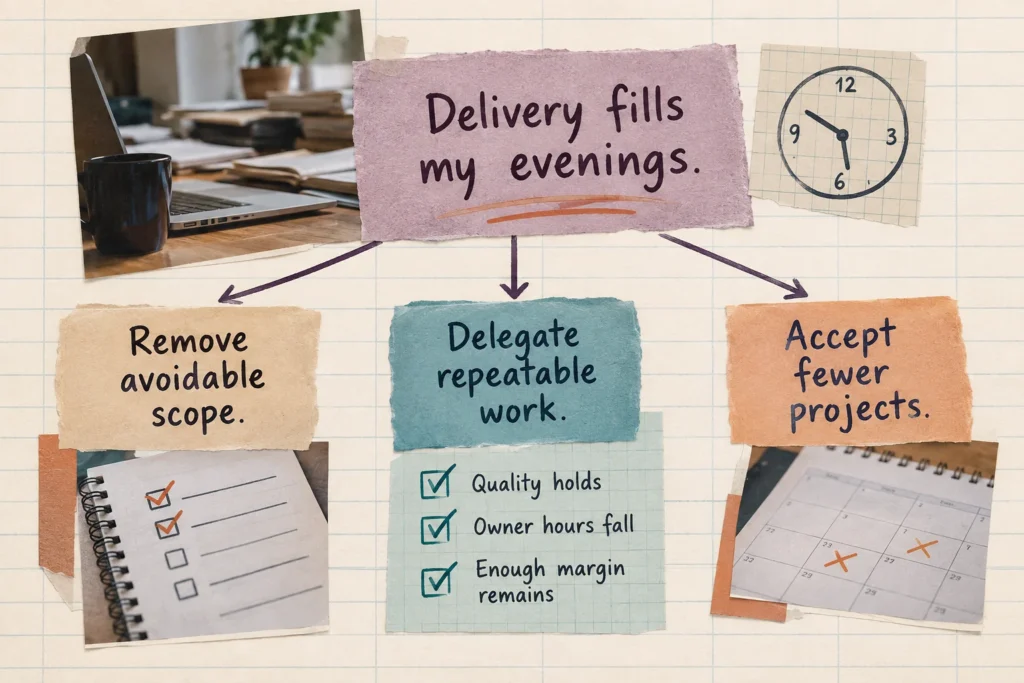
What’s actually filling your evenings?
Look at a few recent projects and separate production from client decisions, revisions, administration, and work outside the agreed scope. Use actual time logs if you have them; otherwise, start recording those categories on your next project. “Delivery takes forever” isn’t specific enough to price a handoff.
Picture me in an imagined Tuesday-night handoff: I’ve opened a file to brief a helper, but three client messages disagree about which version they want. I’m annoyed that my supposed shortcut now needs an explanation I can’t give. Instead of outsourcing the whole project, I keep the client decision and hand off formatting only after the content is approved. The task becomes smaller, and actually transferable.
There should be clear inputs and outputs, and it should be something someone else can check. For scope’s sake, try to limit costly revisions or extras and focus on the core deliverable first. If the work pays poorly, consider price testing to better gauge client willingness to pay, then, if needed, pay the other person. If clients still rely on your judgment, hiring may not remove the bottleneck.
Count the cash, and the work that stays with you
To gauge the value you’re giving, determine the cost of a deliverable and determine the price of revisions. Add all fees, platform fees, integration tools, and handoff costs to give an accurate quote. Separate one-time costs from recurring costs to create an accurate picture of what to expect going forward. The SBA suggests considering recurring and nonrecurring costs over a specific time period. The example costs below are for illustrative purposes only.[1]
Suppose a $900 project has $60 in direct expenses and takes you 12 hours: nine production hours and three hours of client work and final delivery. A contractor takes over production for $240, plus a $20 handoff fee, and tools. Your recurring workload looks something like:
- 3 hours of final delivery client work.
- Briefing: 0.75 hour.
- 1 Hour Review.
- Your revision work: 0.75 hour.
- Coordination: 0.5 hour.
- Total recurring owner time: 6 hours, plus 2 hours of initial setup on the first project.
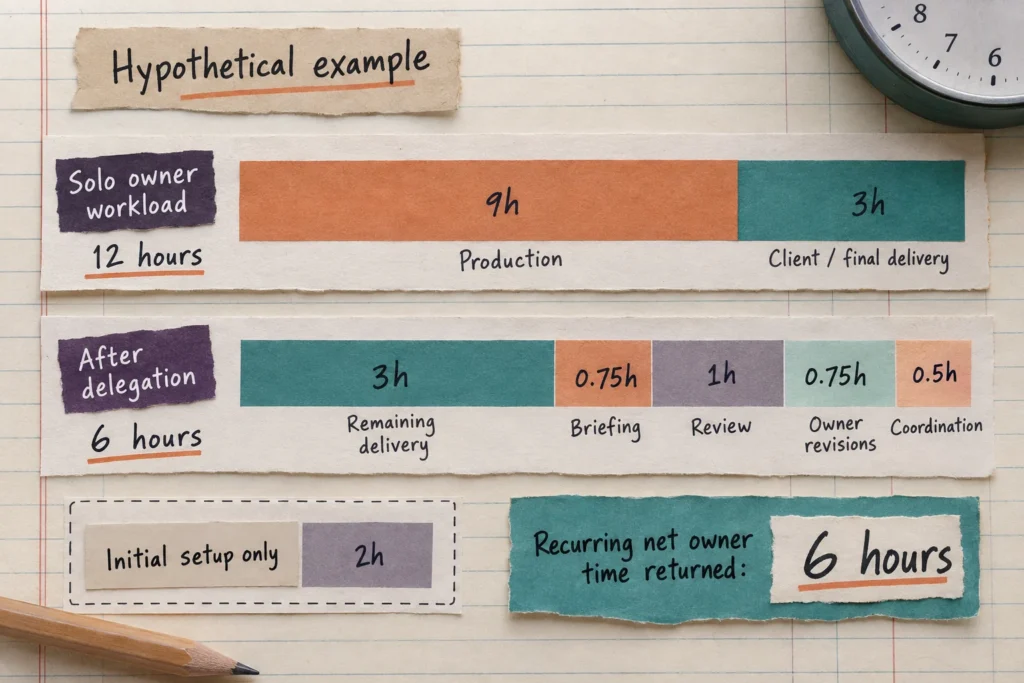
Solo contribution is $900, $60 = $840, or $70 per owner hour. Delegated contribution is $900, $60, $260 = $580, or $96.67 per recurring owner hour. Contribution is the money left before the shared overhead and taxes, not the take-home profit.
You forfeit $260 to reclaim six recurring owner hours, or $43.33 per hour returned. The first project left four hours returned, and unexpected rework added two owner hours and a $60 contractor charge, leaving a contribution of $520 for eight owner hours returned, or $65 per hour returned, which is less than the solo result.
I would also keep cash and time separate. You can come up with a dollar value for your time to make a second comparison, but don’t subtract briefing hours as an expense and then charge yourself for those hours. Also ask when the time returns. Six scattered, discrete intervals of time may not be a free evening, especially if the time returns during off-hours.
Compare relief with doing less
Demand steady state rather than deteriorate by creating new demand for time freed up. With four available projects under the hypothetical assumptions, here’s what accepting different amounts of work would mean:
| Choice | Owner hours | Total contribution |
|---|---|---|
| Four solo projects | 48 | $3,360 |
| Four delegated projects | 24 | $2,320 |
| Three solo projects | 36 | $2,520 |
| Two solo projects | 24 | $1,680 |
Four delegated projects return 24 recurring hours but reduce contribution by $1,040 versus four solo projects. Three solo projects leave $200 more than four delegated ones, but take 12 more hours. Two solo projects match the delegated workload without managing a helper, but leave $640 less. Your income floor matters as much as your calendar.
When considering hiring, think about requiring a standard package with fewer options, capping revisions included, or increasing your price for the next proposal. Narrowing the scope of your services can eliminate work rather than transfer it. Increasing your prices can improve your average contribution, but sales may be affected. Don’t assume all four clients will accept new terms. Extra sales hypothesized to be included in the hiring budget shouldn't be considered. Reclaimed time can be used to rest rather than working to generate revenue.
Some handoffs shouldn’t start yet
Review your client agreement for limitations on subcontracting, required consent, confidentiality, and/or ownership of the work. Obtain client permission prior to subcontracting work. A helper’s NDA will not release you from your obligations to the client. Keep the final version of the work to be subcontracted until specs, accuracy checks, and a deadline are defined.
Ask the client for access only to the information needed and use separate, fictitious data for training, if possible. State expectations for security and ensure they are followed. These are permitted practices for the protection of client information, not a release from all obligations to clients.[5]
“Contractor” status is not determined by a signed document. How a worker is economically controlled and whether the relationship is one of an employer and employee are the primary factors for federal tax classification. Behavioral and financial control do not displace the obligations for worker classification. A short paid trial does not release you from those obligations.[2][3]
CA state ABC test rules differ from other states. When contractors in CA are performing tasks outside the scope of business, as usual, for the hiring firm, the ABC test will ordinarily apply. CA’s test is different from other states, and may include exceptions that change the test. If you are closely controlling how work is being done by an individual, you may want to have your employment classification assessed by a legal expert. A contract will not change the classification, and if you misclassify, you may have to pay employment taxes for that individual.[2][3][4]
Buy a small trial, not an open-ended obligation
Once you receive the required permissions and employment classification is resolved, you may want to try two paid handoffs, with a written scope and no implicit or automatic extension. Set your limits before beginning. Using this example, I would recommend:
Replace your limits with your own numbers. Your maximum delegation budget is the project quote, less your direct costs, less your income floor; keep a separate ceiling for your time. If quality, time, and cash all pass, proceed. Two projects will not prove long-run reliability, but may reveal handoffs that cost too much, or make you work as late as the contractor.
Sources and references
- U.S. Small Business Administration: Manage your business
- Internal Revenue Service: Topic no. 762, Independent contractor vs. employee
- U.S. Department of Labor: Fact Sheet 13: Employee or Independent Contractor Classification Under the Fair Labor Standards Act
- California Department of Industrial Relations: Independent contractor versus employee
- Federal Trade Commission: Start with Security: A Guide for Business
