

Skipping an office is one of the few startup decisions that changes the economics of a new business immediately. It lowers fixed overhead, reduces the pressure to fill a monthly lease, and gives a new operator room to test demand before committing to a permanent location. For many service businesses, that extra flexibility is more valuable than a polished address.
But no office is not the same as no infrastructure. The strongest office-free businesses still need a clear offer, a dependable delivery process, the right legal setup for the work, and a believable reason for clients to trust them quickly. The real question is not which idea sounds easiest. It is which service can be sold, delivered, and repeated without a dedicated premises.
TL;DR
- The best office-free service businesses are delivered remotely, at the client’s site, or with a compact mobile setup stored at home or in a vehicle.
- Strong ideas usually have one of three advantages: recurring demand, a clear before-and-after result, or an urgent buying trigger such as taxes, moves, pets, paperwork, or maintenance.
- Before picking an idea, test it for portability, proof of quality, reachable buyers, repeat business potential, and manageable regulatory risk.
- Avoid common traps such as offering too many services, underpricing travel and admin time, assuming home-based means regulation-free, or treating online reviews casually.
- Start with one narrow offer for one buyer type, then expand only after the first clients show what actually sells.
What actually makes a service business office-free
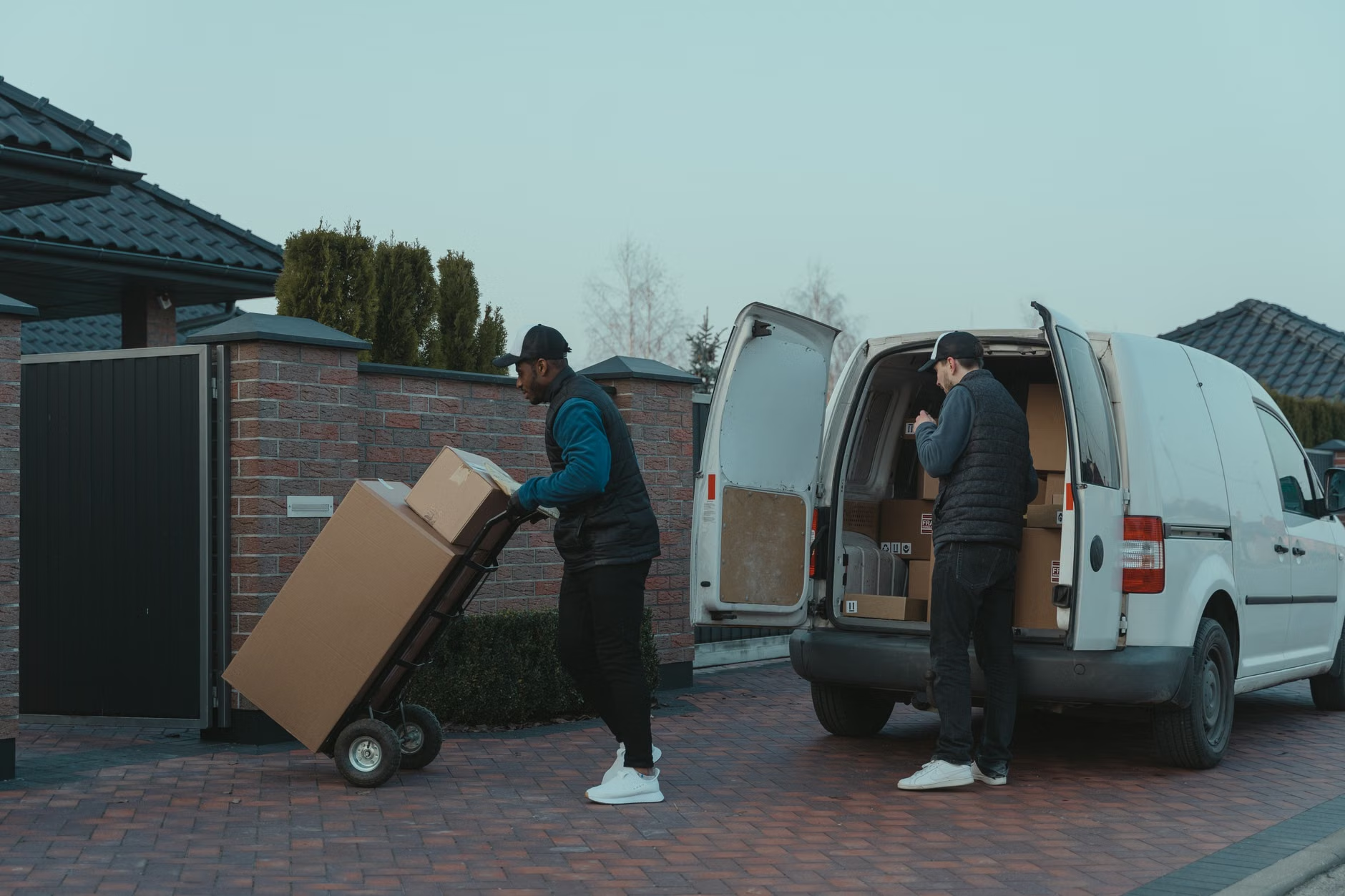
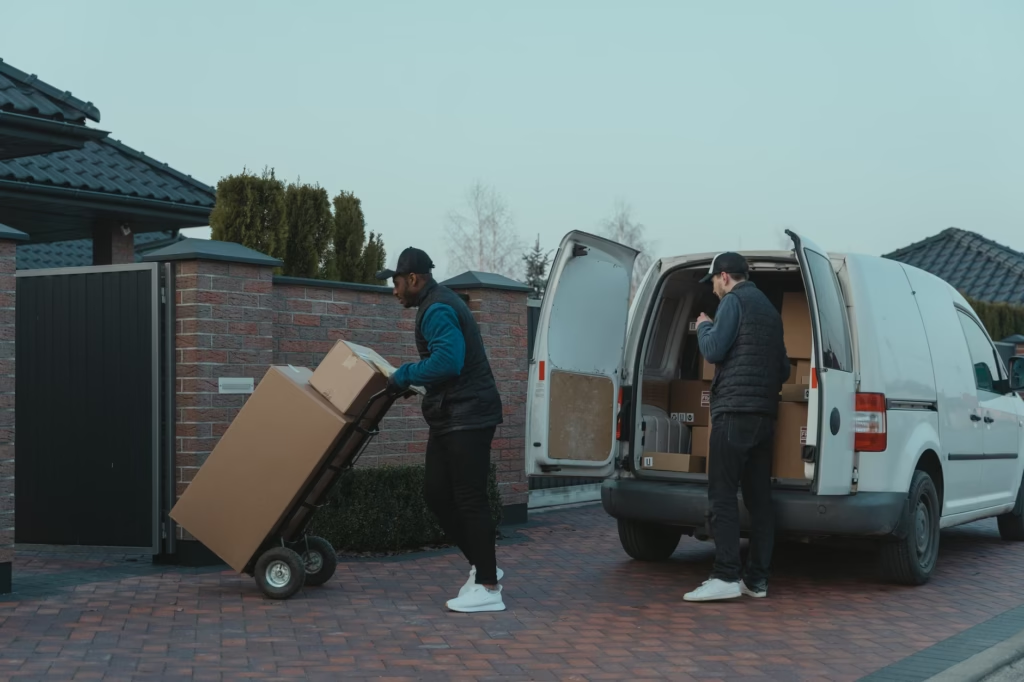
Most viable office-free businesses fit one of three delivery models. First are remote services: work handled from a laptop and phone, such as bookkeeping, tutoring, customer support, or content production. Second are mobile services: work done at the client’s home, driveway, or workplace, such as cleaning, detailing, organizing, or tech setup. Third are route-based services: repeat work performed across multiple stops with supplies stored at home or in a vehicle, such as dog walking, recurring commercial cleaning, or errand support.
What usually does not fit as a true office-free startup is any model that depends on walk-in traffic, large inventory, specialized commercial fixtures, hazardous storage, heavy equipment, or significant on-site staff coordination. A home address may still be your business location in regulatory and tax terms, but that is different from leasing a separate office or storefront.
It also helps to think about the hidden office functions that still exist even when there is no office. Quotes need to be sent. Payments need to be collected. Supplies need to be stored. Client records need to be secured. Routes and schedules need to be managed. If the business cannot handle those basics without becoming chaotic, the office-free advantage disappears fast.
Use the Portable Proof Filter before you pick an idea
A lot of bad business ideas look cheap at first because they avoid rent. That is not enough. A better test is whether the service can travel and whether the buyer can trust it fast enough to hire you. One practical way to sort options is a simple screening method called the Portable Proof Filter.
- Delivery travels well. The work can be done online, at the client’s site, or with a compact kit that fits in a home storage area or vehicle.
- Proof is easy to show. A prospective client can judge your competence through samples, certifications, before-and-after photos, references, or a clearly explained process.
- The buyer is easy to find. You can name where the first 25 potential customers already spend time, whether that is in a neighborhood, an industry niche, or an online channel.
- The service has a repeat path. Good office-free businesses often lead to recurring work, seasonal work, ongoing retainers, or frequent referrals.
- The rules are manageable. The work does not quietly require a special facility, local approval you have not researched, or a level of insurance and licensing that changes the economics.
Score each idea from 1 to 5 on those five tests. Any idea with a weak score on the rules question deserves extra caution, even if the marketing angle looks attractive. An office-free business is supposed to reduce friction, not hide it until later.
Ten service businesses that often work well without dedicated space
The ideas below are not equal in every market, and none of them are automatic wins. What makes them promising is that they can usually be delivered from home, online, or at the client’s location without relying on a leased office. The last column matters just as much as the idea itself, because every office-free model has a pressure point.
| Business idea | Typical delivery model | Why it can work without an office | Main friction to solve first |
|---|---|---|---|
| Bookkeeping or payables support | Remote | Recurring administrative need, low physical overhead, easy to schedule around deliverables | Trust, confidentiality, and consistent reporting |
| Virtual assistant or operations support | Remote | Founders and small teams often need inbox, scheduling, and follow-up help more than a physical location | Scope creep and vague expectations |
| Online tutoring or test prep | Remote or in-home | Clear session-based delivery and measurable progress in many niches | Differentiation and client retention |
| Content repurposing or social media support | Remote | Experts need help turning long-form work into posts, clips, and newsletters | Proving business value beyond activity |
| Residential cleaning | Client home | The service is performed where the problem exists, and repeat schedules are common | Travel time, reliability, and insurance |
| Mobile car detailing | Client driveway or fleet lot | Convenience and visible results are part of the sale | Weather, equipment logistics, and route density |
| Pet sitting or dog walking | Client home or neighborhood | Neighborhood-based demand can repeat quickly once trust is established | Availability during holidays, emergencies, and local rules |
| Home organizing and unpacking | Client home | Strong triggers such as moving, downsizing, or renovation create urgency | Estimating labor time and handling emotionally stressful projects |
| Small-business tech setup and device support | Client site or remote | Many households and small firms need Wi-Fi, printer, device, and basic workflow help | Liability around data, accounts, and troubleshooting boundaries |
| Mobile notary or signing support | Client location | Convenience is the core value, not the location | State-specific commissioning requirements and scheduling peaks |
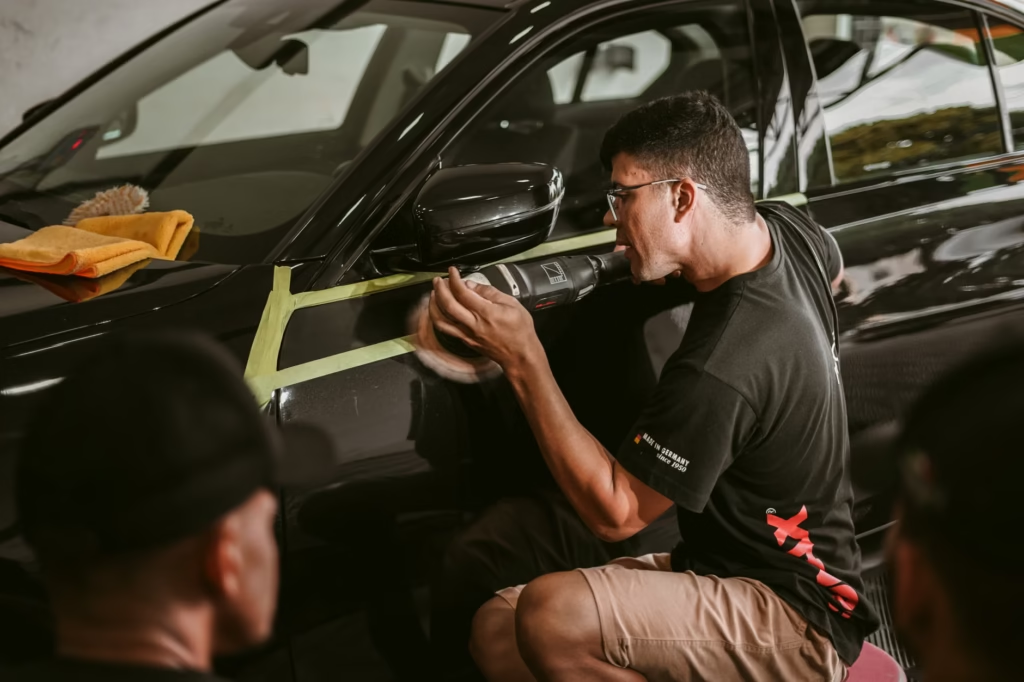
The pattern matters more than the list. Strong office-free services are usually tied to a recurring chore, a visible result, or a time-sensitive problem. Bookkeeping, cleaning, pet care, and admin support repeat. Detailing and organizing show obvious before-and-after value. Notary work and tech setup often solve problems that need attention now, not someday.
That is also why many vague, broad offers struggle. General lifestyle consulting, undefined freelance help, or “I can do anything” service packages sound flexible but are harder to buy. Buyers respond better to specific pain relief than to open-ended capability.
Choose the lane that matches your real advantages, not just your interests
People often choose an idea based on what seems trendy or what appears simple from the outside. A stronger approach is to match the business to assets you already control: skill, credibility, equipment, schedule flexibility, neighborhood access, industry familiarity, or an existing network. Those advantages shorten the gap between starting and getting paid.
Consider a hypothetical example. Someone with several years of administrative experience in property management might describe the business idea as virtual assistant work. That is still too broad. A tighter, more saleable version could be leasing paperwork coordination, vendor scheduling, follow-up systems, and inbox cleanup for small landlords or property managers. By contrast, someone who already owns compact detailing equipment and knows how to work efficiently outdoors may be better positioned to sell recurring maintenance packages to busy households or local fleets. Both are office-free businesses, but the second person should not force a laptop service just because it sounds modern, and the first person should not assume a mobile service is easier just because it looks tangible.
- Remote service businesses fit best when your value comes from judgment, organization, communication, or specialized knowledge.
- Mobile household services fit best when results are visible, trust can be built locally, and travel time stays efficient.
- Local B2B route services fit best when a business customer needs reliability more than creativity and can buy on a recurring schedule.
Start with an offer that is narrow enough to buy
New service businesses often stall because the offer is too broad, not because demand is missing. The first version should solve one expensive annoyance for one type of customer in one clear way. That makes pricing easier, sales conversations shorter, and fulfillment less messy.
- Pick one buyer. Not homeowners in general, but busy pet owners in one neighborhood, or solo attorneys who need bookkeeping cleanup, or families preparing for a move.
- Name one outcome. A cleaner house is vague. Weekly reset cleaning for occupied homes is clearer. Better marketing is vague. Turning one podcast episode into a newsletter and short-form clips is clearer.
- Define delivery. Say whether the work happens remotely, on-site, by appointment, on a route, or through a monthly retainer.
- Set scope boundaries early. Decide what is included, what is extra, and what you do not do at all. This protects margin and avoids client confusion.
- Choose a pricing structure that matches the work. Session-based, project-based, monthly retainer, or route-based recurring pricing can each make sense depending on the service.
- Build proof before polishing the brand. One strong sample, a short case-style explanation, or a few credible reviews usually matter more than a logo package.
For office-free businesses, recurring revenue usually makes the model sturdier. A monthly bookkeeping package, weekly cleaning schedule, standing dog-walking route, or ongoing operations retainer makes planning easier than constantly chasing one-off work. One-time projects can still be useful, but they are often best treated as a feeder into repeat business rather than the entire strategy.

The invisible infrastructure still matters even when there is no office
A lease is optional. The operational basics are not. Even very small service businesses still need to make deliberate decisions about structure, permits, taxes, insurance, records, and naming. Skipping those questions can be costly later, especially once the first good client arrives and asks for an invoice, proof of insurance, or a formal agreement.
- Choose a legal structure on purpose. A sole proprietorship may be simple, but a riskier service or one tied to meaningful personal liability may call for a different structure after professional advice.
- Do not assume home-based means regulation-free. Depending on the service and where you operate, local zoning, county rules, or state licensing may still matter even without a separate office.
- Separate business money from personal money early. A dedicated bank account and basic bookkeeping system are easier to set up at the beginning than to reconstruct later.
- Buy insurance that matches the actual work. Depending on the model, that could include general liability, professional liability, a home-based business rider, or coverage tied to a business vehicle.
- Treat taxes as an ongoing process, not a year-end surprise. Self-employment often brings recordkeeping and payment responsibilities that feel easy to postpone until they become painful.
- Check name conflicts before you commit. A quick business name search is not the same as deeper trademark clearance, but it is far better than printing materials first and discovering a problem later.
- If you add helpers, worker classification is a legal issue, not just a label. Repeatedly assigning shifts and controlling the work can create risks if you assume everyone is simply a contractor.
- Ask for honest reviews, but do it carefully. Buying fake reviews, nudging only likely fans, or using undisclosed connections can create avoidable marketing and compliance problems.
One overlooked point: a business can be office-free and still have a qualifying home office for tax purposes, but the rules are specific. Qualified taxpayers should review the IRS guidance carefully rather than assuming any desk in a spare room counts.

A 30-day launch plan that keeps the idea from staying theoretical
- Days 1 to 3: Run three possible ideas through the Portable Proof Filter and choose one that scores well on portability, proof, reachable buyers, repeat potential, and regulatory simplicity.
- Days 4 to 7: Speak with at least a handful of likely buyers or referral partners. Ask what they currently use, what frustrates them, what they pay for now, and what would make switching worth the effort.
- Week 2: Draft one tight offer, one simple agreement, one invoice template, and one page that explains the service, the process, and how to book.
- Week 2: Handle the launch basics that apply to your situation, including structure, registration, tax ID needs, permits, bank setup, and insurance.
- Week 3: Deliver a pilot version for a limited number of clients. Watch where time disappears, where communication breaks down, and what clients ask for that you did not expect.
- Week 4: Tighten scope, improve pricing, collect honest feedback and reviews, and create small proof assets such as before-and-after images, deliverable samples, or process screenshots where appropriate.
- End of month: Review three numbers that matter more than vanity metrics: how many inquiries turned into paid work, how long fulfillment actually took, and whether the service looks repeatable without exhausting you.
Common failure patterns in office-free service businesses
- Picking an idea that quietly needs more space, storage, traffic, or regulation than expected.
- Pricing only the visible labor and forgetting travel, setup, communication, software, supplies, or cancellation risk.
- Trying to attract everyone instead of becoming the obvious fit for one buyer and one problem.
- Believing a website or social account is proof of demand before anyone has committed real money.
- Ignoring route density for mobile services, which can turn a busy calendar into a low-margin mess.
- Waiting too long to install simple systems for scheduling, payment collection, client notes, and follow-up.
The real advantage is flexibility, not the absence of overhead
A service business without an office works best when the lack of premises is a strategic advantage, not a compromise. It should make the business easier to test, easier to sell, or easier for the client to use. The smartest next step is usually not to gather more ideas. It is to choose one practical model, narrow the offer, verify the rules, and see whether real buyers respond. That is how an office-free business becomes a real business instead of a low-cost hobby with a business name.
Frequently asked questions
Do I need an LLC before getting the first client?
Not always. Many people start more simply, especially while testing demand. But the right choice depends on risk, client expectations, taxes, state rules, and how much liability the work could create. For higher-risk services or situations involving contracts, vehicles, homes, or sensitive data, it is worth getting professional guidance earlier rather than later.
Can I meet clients at home if I do not have an office?
Possibly, but it is not automatically a good idea. Privacy, parking, insurance, local zoning, homeowner or landlord rules, and the nature of the service all matter. Many office-free businesses are operationally cleaner when meetings happen remotely or at the client’s location instead.
Which office-free service ideas are most likely to become recurring?
Services tied to routine maintenance, administration, or care usually repeat more naturally than one-time projects. Bookkeeping, virtual support, residential cleaning, dog walking, and some tech maintenance services often have stronger recurring potential than event-based jobs.
Should a new service business start locally or remotely?
If trust is the biggest barrier, local can be easier because referrals, neighborhoods, and visible work help shorten the sales cycle. Remote can work very well when the service is specialized, the outcome is easy to explain, and proof of competence is strong enough that distance does not matter much.
When is it time to add an office or workspace?
Usually when a physical space clearly improves conversion, efficiency, staffing, storage, or client experience enough to justify the fixed cost. Adding space too early can lock a young business into overhead before the service, pricing, and demand are stable.
References
- U.S. Small Business Administration – Launch your business – https://www.sba.gov/business-guide/launch-your-business
- U.S. Small Business Administration – Choose a business structure – https://www.sba.gov/business-guide/launch-your-business/choose-business-structure?_conv_s=si%3A10%2Ash%3A1739447885211-0.2956578863665209%2Apv%3A2%3D&_conv_v=vi%3A1%2Asc%3A10%2Acs%3A1739447885%2Afs%3A1738330299%2Apv%3A12%2Aseg%3A%7B10031564.1-10034364.1-10034366.1-10034739.1%7D%2Aexp%3A%7B100344709.%7Bv.1003169483-g.%7B%7D%7D-100344917.%7Bv.1003170087-g.%7B%7D%7D%7D%2Aps%3A1739445473&autm_content=
- U.S. Small Business Administration – Apply for licenses and permits – https://www.sba.gov/business-guide/launch-your-business/apply-licenses-permits
- U.S. Small Business Administration – Get business insurance – https://www.sba.gov/business-guide/launch-your-business/get-business-insurance
- Internal Revenue Service – Self-employed individuals tax center – https://www.irs.gov/businesses/small-businesses-self-employed/self-employed-individuals-tax-center?os=wtmb5utKCxk5&ref=app
- Internal Revenue Service – Simplified option for home office deduction – https://www.irs.gov/businesses/small-businesses-self-employed/simplified-option-for-home-office-deduction
- Federal Trade Commission – Soliciting and Paying for Online Reviews: A Guide for Marketers – https://www.ftc.gov/business-guidance/resources/soliciting-paying-online-reviews-guide-marketers
- U.S. Department of Labor – Fact Sheet 13: Employee or Independent Contractor Classification Under the Fair Labor Co – https://www.dol.gov/agencies/whd/fact-sheets/13-flsa-employment-relationship
- U.S. Patent and Trademark Office – Online trademark tools – https://www.uspto.gov/trademarks/basics/online-tools
