


Usually, yes: require money before starting if otherwise you’d spend cash you can’t spare or accumulate more unpaid work than you can afford to lose. But I wouldn’t choose a deposit percentage first. I’d choose a payment schedule that keeps your exposure manageable all the way through the project, not just on kickoff day.
Deposits and periodic payments are established ways to handle projects where expenses and labor come before completion. That doesn’t make 50%, or any other percentage, the right answer for your project. A deposit can pay for supplies while leaving most of your evenings unpaid.
Imagine I’m about to start a copywriting project on Tuesday evening. The client has paid half, so I feel comfortable, until I notice that the next payment comes after three weeks of drafting and revisions. My calendar is already full of promised work. I’d rather have the slightly awkward payment conversation now than discover that “half upfront” bought me very little protection.
What’s actually at risk before the next payment?
Distinguish three numbers: cash you spent, the hours you worked and the client’s contractual balance. Covering expenses helps manage cash flow. However, terms can also unmanage cash flow if you work too many unpaid evenings.
To plan, uncovered exposure is equal to cash costs incurred + (hours worked x hourly value), + payments received. If the result is negative, expose yourself to zero uncovered loss, and not to profit. This method shows how payments fail to cover costs and shouldn’t be read to guarantee that payments received can’t be refunded or reversed.
You should choose an hourly value for planning that helps you evaluate the significance of time lost. This shouldn’t be interpreted as a market benchmark or legal amount you may expect to recover after a cancellation. Prior to each payment, consider work you will do to process the payment; this is where you should look to evaluate whether a cash deposit is sufficient.
The same $1,500 job can expose $0, or $1,500
Take one hypothetical $1,500 website-copy project: $150 in expenses at kickoff, plus three stages of 10 hours each. Each stage was valued at $45, for a total of $450 per stage. The total costs and labor value reached $600 after the outline, $1,050 after the first complete draft, and $1,500 after the revisions.
| Schedule | When money arrives | Peak uncovered costs and labor |
|---|---|---|
| Full upfront payment | $1,500 before kickoff | $0 |
| Deposit, then final balance | $750 before kickoff; $750 after final approval | $750 before final payment |
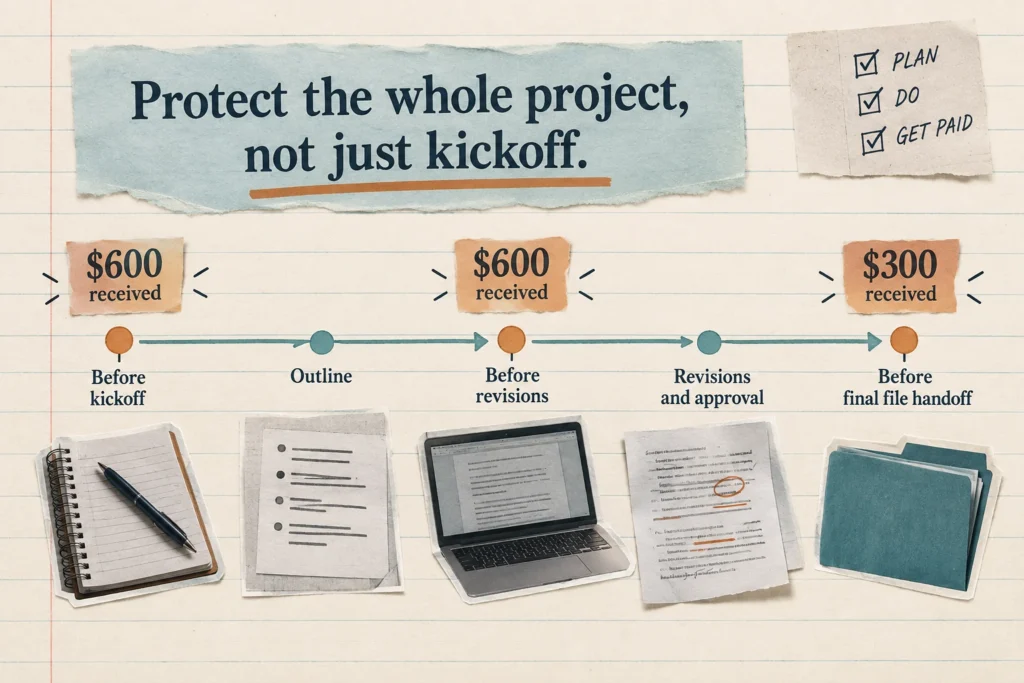
| Staged payments | $600 before kickoff; $600 after draft acceptance, before revisions; $300 after final approval | $450 before the middle payment |
| Payment on completion | $1,500 after final approval | $1,500 before payment |
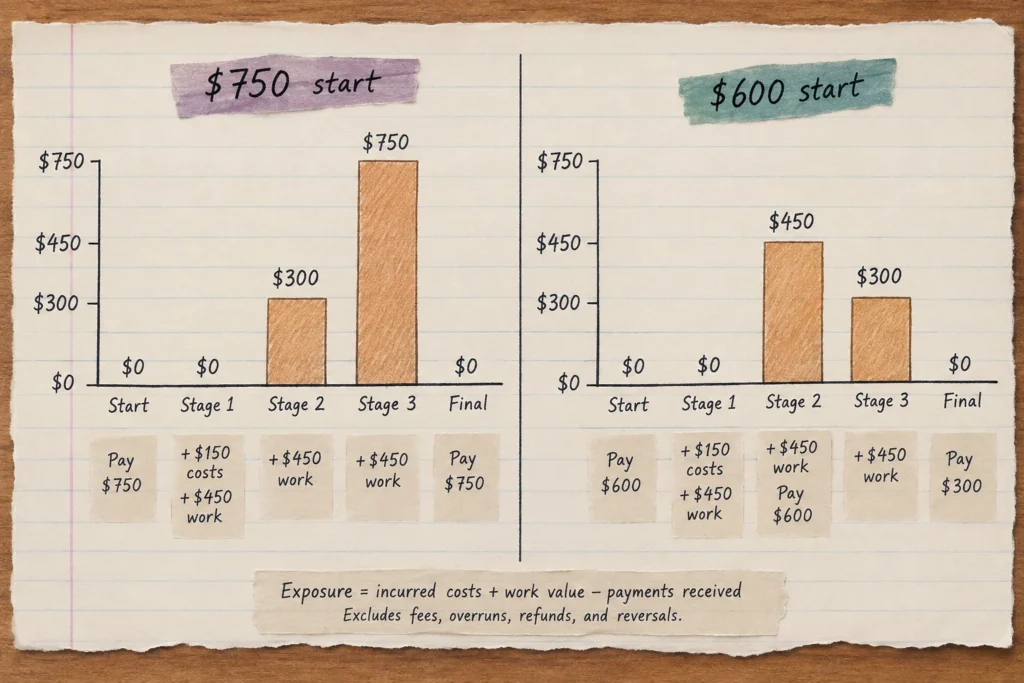
With the $750 deposit, $150 covers expenses and $600 covers labor value. That’s about 13.3 hours at $45, not all 30 hours. Before the final payment, your uncovered exposure is $1,500, $750 = $750. Half the price upfront still leaves half this project’s costs and labor uncovered at the end.
I think the staged payment schedule is better, even with the initial loss in revenue. Exposure is $1,050, so $600 = $450 before the middle payment. After that payment is made, receipts total $1,200, with $1,500, $1,200 = $300 exposed. The largest exposure is $450, rather than $750; the additional payment is more important than the initial payment percentage.
The numbers do not consider processing fees, taxes, overruns, refunds and payment chargebacks. They assume you stop at payment gates. If you finish revisions while the second payment is pending, exposure rises to $900. A payment is not an agreement, however politely you've worded it.
What would change the terms I’d offer?
An skeptical new client may have reason to hesitate paying everything upfront for an unknown product. Stages enable the client to examine something concrete for review without asking you to take a large credit risk. Payment on completion may work for a small, short, inexpensive and timely paid assignment for a returning client. Friendly messages don’t always equal payment history. A good record on small jobs may not encourage you to finance a larger job, though.
You can find real procurement restrictions, even if they aren’t affordable for you. Find out who decides acceptability, what makes an invoice valid, and when the payment will be made. The official New York model freelance agreement deals with installments and internal invoice processing deadlines, and helps with this discussion, but is not a rule, nationwide. If payment in advance is forbidden, ask if the client can pay the expenses directly, or make a smaller payment. Payment in advance, or direct payment by the client, will not protect your labor if you work while there is a long payment due process.
I would also be more cautious if the work is specific to a client (i.e. research or designs that have little value if used for another client). Reusable work may ease the loss, but only if it is legal to use it for another client, and if there is the possibility that the work will be purchased by another party. Don’t subtract an imaginary resale from the cash and time you're putting at risk.
As a project gets longer or larger, add payments before the unpaid hours exceed what you can afford to lose. Revisions and administration count too; if the estimate grows, renegotiate before taking on the extra work. If your limit is $300, even our $450-peak schedule needs an earlier payment or a smaller phase. The better schedule still has to fit your wallet.
Payment terms you can actually propose
For the purposes of this project, I would ask the client to agree to the terms below. These terms would be coupled with a scope that described the deliverables and included revisions. Finally, I would avoid leaving acceptance to “satisfactory work” as this would give the client and I a concrete standard against which to evaluate changes that are needed.
- After the agreement is signed, we will begin work as soon as we receive the $600 first installment payment. This payment will be applied towards the $1,500 total.
- Within three business days of each review submission, the client sends written acceptance or specific differences from the agreed scope. Silence pauses scheduling rather than triggering the next stage.
- The next $600 is due within five business days of acceptance of the complete draft; revisions begin after payment arrives. The final $300 has the same five-business-day deadline following final approval. Editable final files and the agreed rights transfer follow full payment.
- After written notice, overdue invoices pause further work and delivery. If the payment due date is extended, or more work is requested, the delivery date for all work will be extended as well.
- If a contract is cancelled, the work completed as of the time of cancellation is valued at the hourly rate of $45, plus any approved and non-recoverable expenses, and less any payments received. An agreement to arbitrate will specify the amount owed or refunded.
This is an example to negotiate terms, not a contract in and of itself. Refunds, cancellation charges, suspension, late fees, and transfer of rights, will be governed by the terms of the contract and the law. A deposit will not be considered “non-refundable” simply because it is labeled as such. For large commitments or if a client has a conflicting contract, it would be advisable to have a small business contract reviewed by an attorney in the relevant jurisdiction.
New York's Freelance Isn't Free Act is an example of a state law, not a federal law.
Received money still isn’t a guarantee
Deposits do not impact the outcome of a dispute. Stripe mentions in their documentation that a card dispute can result in the disputed amount and a dispute fee being deducted from your balance. Stripe helps facilitate your dispute response, but the decision is made by the card issuer. Other payment processors and methods have their own rules as well.
Stick to the agreed terms for the scope of work, changes, approvals, delivery records, and correspondences relating to refunds, as the project progresses. Relevant records can help support a dispute response, but do not guarantee a positive outcome.
Prior to quoting, know where you would have the most cash and hours exposed. If you would be negatively impacted to lose that cash, move a payment forward, adjust the phase to a smaller duration, or decline the terms. You can help a buyer work to their process, without having to fund it.
Sources and references
- SCORE: How to Collect The Money You Are Owed (2017-11-28)
- Freelancers Union: Contract Creator
- New York State Department of Labor: Freelance Worker Agreement
- Stripe: How disputes work
- Stripe: Dispute sample evidence packets
- New York State Department of Labor: Freelance Isn't Free Act
