


A paid course or coaching program is worth considering when it addresses a specific problem, promises the right kind of help in writing, and fits your budget even if it produces no income. I wouldn’t let a student’s revenue screenshot fill in any of those blanks. You’re buying instruction or support, not that person’s outcome.
Picture me, in an imagined example, watching a course preview after dinner while an unfinished freelance proposal sits in another tab. The instructor explains how to find clients; I’m stuck on what to charge this one. I feel the pull of having someone guide me, then close the checkout page and ask whether anyone will actually review my proposal. That’s the help I need.
Name what you need to do differently
“Earn an extra $1,000 a month” is not a learning need. Come up with a price for a service, build a sales funnel, determine why you’re losing prospects, etc. Then see if there’s a lesson, exercise, or review that helps. If not, a bigger bundle won’t help.
I’d evaluate a lesson sample and work sample of an instructor, and not base my judgment on follower counts, or a coaching certificate. The FTC states that to become a business coach there’s no requirement for a license. That’s not to say coaching is worthless. Rather, it means the coaching title tells you little to nothing about the instructor’s ability to teach your desired task.
| What you’re buying | What it can help with | What to get in writing |
|---|---|---|
| Recorded curriculum | Learning a process you can practice independently | Lesson topics, sample teaching, prerequisites, access duration, and update policy |
| Individualized feedback | Finding mistakes in your actual proposal, pricing, product, or outreach | Who reviews your work, how many reviews, format, turnaround, and submission limits |
| Community access | Peer discussion, accountability, and shared experience | Access duration, moderation, meeting schedule, and whether expert replies are promised |
“Weekly coaching” might mean you get added to an already large group call, and your question never gets answered. A community can seem busy without being helpful. You should always ask how and when your work will be critiqued. A sample lesson can only show you a teaching style, not how extensively someone will critique your work later on.
A success story leaves several questions unanswered
An endorsement can be genuine and still be poor or no evidence for your purchase. Five successful students can be very different among 20 purchasers versus 20,000. Money earned by a program does not reveal how much was spent on advertising or refunded. A program’s creator may have benefitted by selling their audience, but the results or earnings alone can’t separate how much the teaching benefitted.
If results are atypical, the representation of results needs to be clear. A general "results not typical" disclosure doesn't specify expected results. How the FTC guidance applies depends on the ad. Compensation, commissions, or free access also need to be considered when weighing an endorsement, but they do not automatically mean the endorsement is false.
If the seller claims to have results data, I’d ask how the results were determined, who was surveyed, how many purchasers responded, and what time period the results reflect. “Results” can mean revenue or profit. Overall, independent reviews can give you some insight on whether feedback was given or if purchasers were refunded, but they can't give an accurate prediction of future sales.
The teaching in a course can be excellent enough to still make it worth buying, even without reliable earnings data. However, in the absence of such data, I wouldn’t base repayment on earnings.
Add up the money, and the evenings
Take a look at the entire repayment schedule, not just the monthly payment. When considering financing options, look at the amount borrowed, APR, term, fees and the total repayment. The CFPB loan guidance provides a good framework. Manageable monthly payments don’t always mean affordable borrowing costs. You will also need to factor in the tools required for the job, the cost of implementation, renewals, and any upgrades necessary to provide the service or product promoted.
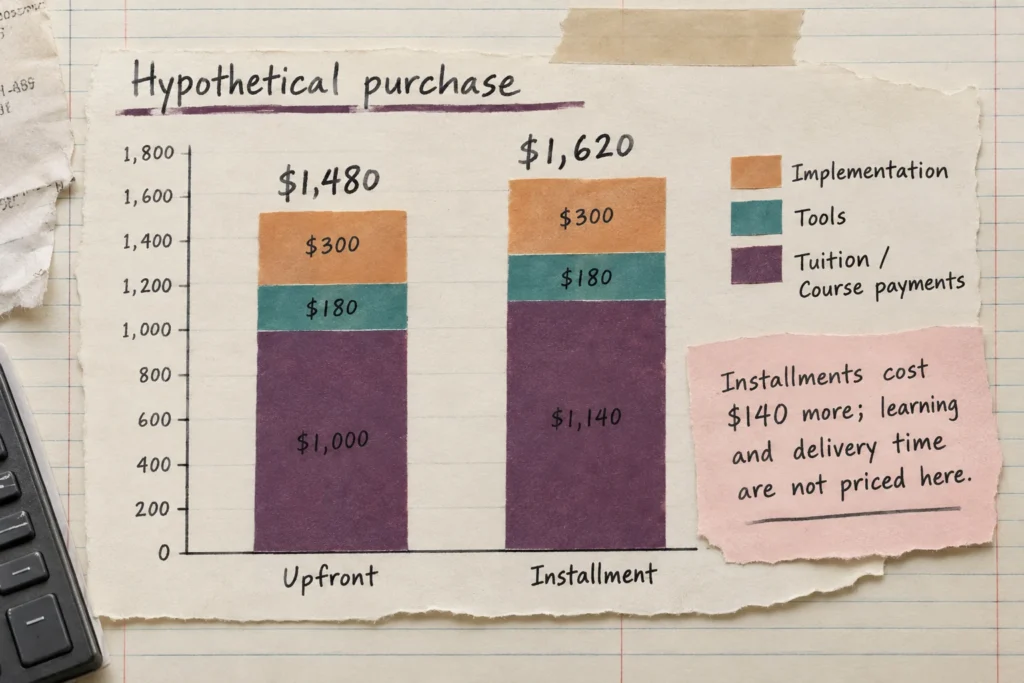
Here’s a hypothetical. The tuition for a program is $1,000, or six payments of $190 for a total of $1,140. The planned test required by the program costs $180, and implementation costs another $300. The total cash outlay upfront would be $1,480 or $1,620 with the payments. The difference is $140. The $1,000 tuition is already included in the $1,620, so you don’t need to add it.
Using the same example, the lessons for the program consist of eight hours over six weeks, and calls comprise four hours over six weeks. Implementation takes 36 hours, for a total of 48 hours, or eight hours a week. Place those hours on your calendar. Fixed call times also need to be placed on your calendar. Video runtime does not equal the workload and an unbooked evening does not equal an evening you can give away.
They say every additional assignment brings in an extra $135, with the direct costs of each assignment being recuperated. That means 12 additional assignments would cover the $1,620 total cost. Once again, that's just the cash recovery; it doesn’t include the 48 learning hours, labor on those assignments, or taxes. Nor does it say if you will find those customers. I think this calculation is very good, since it turns “the course will pay for itself” into an actual workload question.
Can you evaluate the help before the refund window closes?
Read the refund conditions before paying. Factors to look out for include the deadline, required assignments or attendance, exclusions, how to submit a request, and what is deemed an “ordinary” refund window. In a hypothetical offer with a day 14 refund deadline and a first individualized review on day 21, you can not assess that review within the ordinary refund window.
Ask for a sample paid review, rather than treat the guarantee as a free sample.
If financing is separate from the tuition cost, get the written explanation of how an approved refund affects the loan, fees, and payments. Don't assume the tuition refund automatically cancels your obligation to pay. Save the sales promises and agreements. If the seller won't provide material terms before checking out, consider that a reason to not complete the purchase.
Buy the smallest useful piece of help
One-time expert reviews are comparatively inexpensive. Specify what you want reviewed, the type of feedback you will receive, and when you will receive it. A short, paid teaching module can also be used to see if the instructor can help you complete a single task.
For simple business-related questions, the SBA mentions no-cost resources, such as SCORE’s mentoring and individualized advising offered through the Small Business Development Centers, although local expertise and responsiveness can vary. If your uncertainty is whether customers want your offer, for example, a small demand test could be more helpful than a lesson.
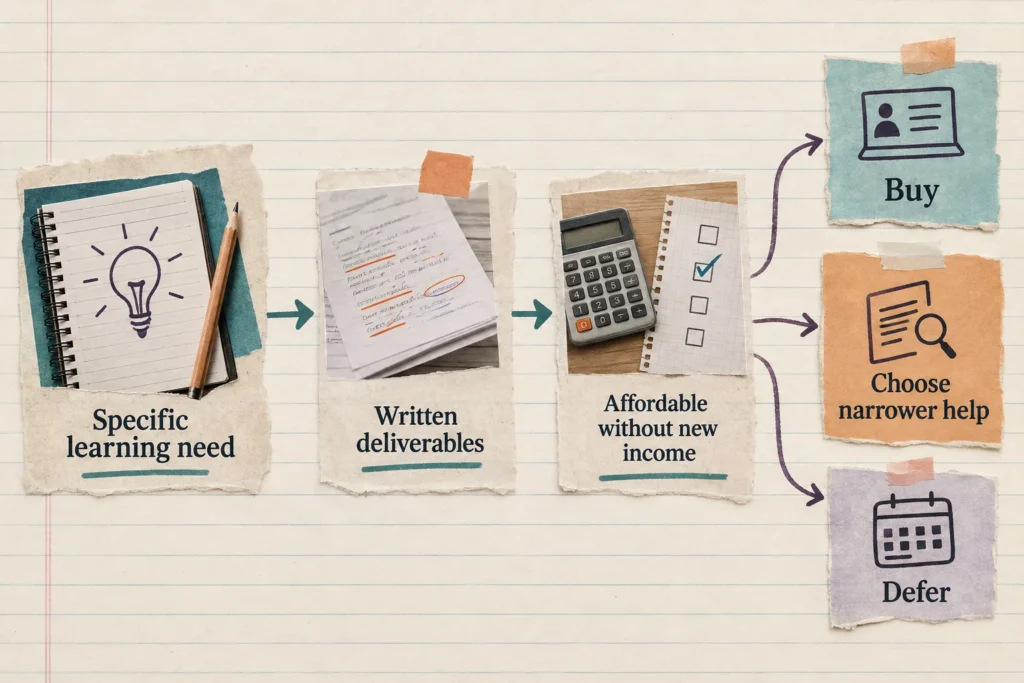
- What task or decision will this help me handle, and which deliverable addresses it?
- Who provides feedback, on what work, how often, and by when?
- What will be the full, implementation cost (i.e., price, financing, tools, renewals, upgrades), and is this something I can afford?
- Will this fit in my calendar, and can I afford the cost with no new income?
- What are the written terms for a refund, and can I assess the promised support before the deadline?
Buy when the answers support the purchase, and choose help to remove a more pressing constraint when the cost is justified and delivery terms are clear. Defer when delivery, cost, and terms are unclear. Be wary of pressure sales tactics and an escalating series of upsells, especially if the FTC is specifically warning about this. You can be in real need of help and not need this specific offer.
Sources and references
- Federal Trade Commission: When a Business Offer or Coaching Program Is a Scam
- Federal Trade Commission: FTC's Endorsement Guides: What People Are Asking
- Consumer Financial Protection Bureau: How do I compare auto loan offers? (2024-01-30)
- U.S. Small Business Administration: Resource Partners
