


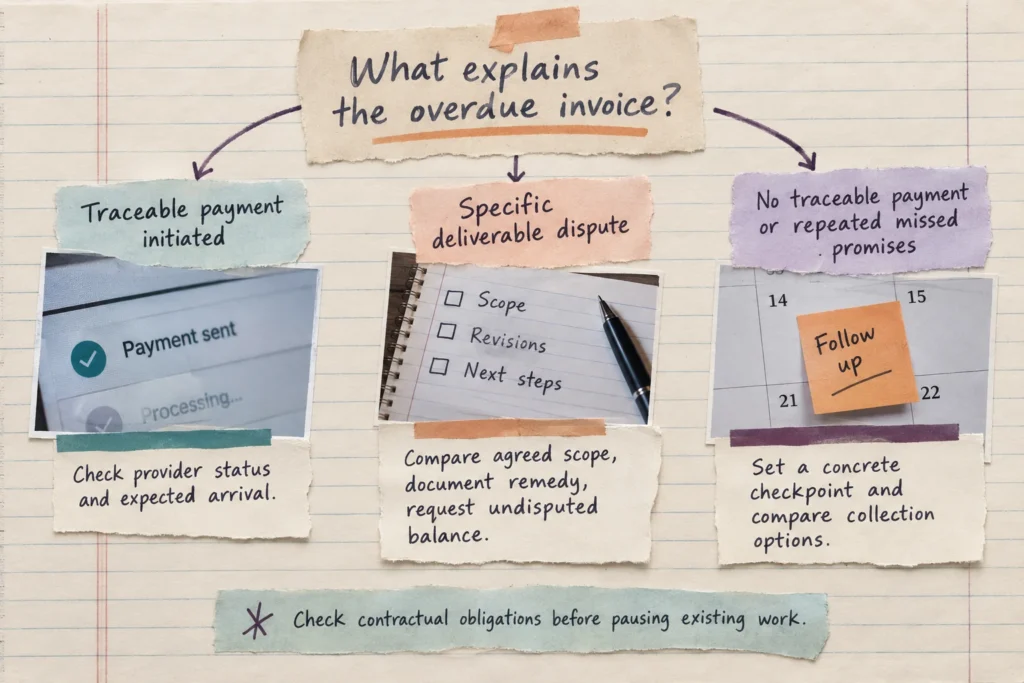
Ask for a specific payment date and evidence of the payment status. Do not accept "soon" as an answer. First, check your agreement to see when payment is due and whether your client has received the invoice. Then determine whether you are dealing with a traceable processing delay, a specific complaint about the service, or broken promises. If that is the case, and your client continues to refuse payment, I'd be prepared to send the final demand. I wouldn't be sending unpaid work to avoid an uncomfortable email, but I wouldn't be issuing threats either.
Picture me, in an imagined example, opening a client’s “accounts is handling it” email while an extra revision they’ve requested sits half-finished on my laptop. I’m tempted to finish it so I don’t seem difficult. But the email has neither a payment date nor an accounts contact, and I haven’t committed to this extra work. I close the draft and ask who owns payment approval. A friendly tone isn’t a payment status.
Find the gap between your invoice and their payment
Start with the agreement beside the invoice. Is payment due on a fixed date, after invoice receipt, after completion, or after an agreed acceptance milestone? That distinction can explain why you and billing are counting from different days. Your invoice should reflect the agreed terms, not introduce new ones afterward. The NYC model freelance contract illustrates separate scope, payment, and modification terms, but it can’t fill gaps in your own agreement.[2]
Then find where the invoice stopped. Your project contact may not be the person or legal entity that owes you, or the person who approves payment. Ask billing whether it received the invoice and has the purchase-order number, vendor details, and payment instructions it needs. If approval is complete, ask whether payment has actually been initiated. I’d want the initiation date, method, transaction reference, and expected arrival date, not just confirmation that someone clicked “approved.”
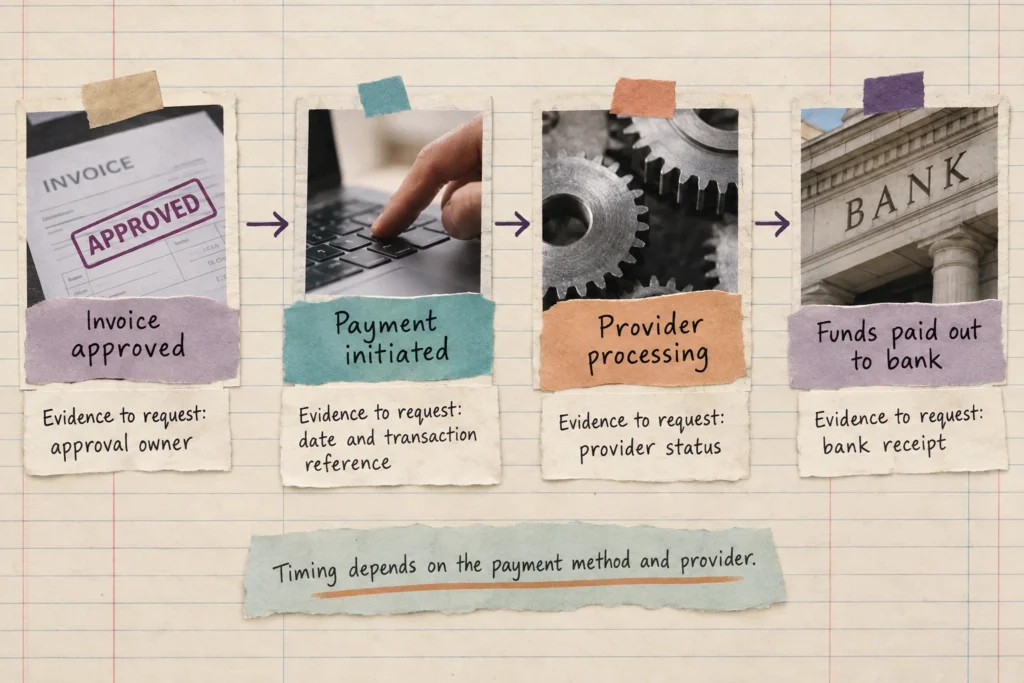
Let the billing contact have the issue, rather than sending it company-wide. If you explain it over the phone, send a short message to that effect. You want to create a case that can be acted on.
Let their explanation change your response
The payment is actually processing
A transaction reference gives you something to investigate that “finance has it” doesn’t. Check your payment account’s status when available. Stripe ACH Direct Debit, for example, can take up to four business days to acknowledge success or failure, and settlement and payout to your bank are separate stages. That’s a Stripe-specific example, not a universal bank-transfer deadline or proof that the client met the contractual due date.[1]
If the case supports the explanation, I’d go with them on when to check again rather than send stern emails while the transaction settles. There is some level of reassurance knowing you’ve got something you can keep a eye on. If it doesn’t show up or fails to arrive by the expected date, request the provider’s status and a time-stamped action plan to replace the payment.
They identify a problem with the work
“We’re not happy with it” can refer to multiple things, including payment or the repair. If the repair is the issue, it’s time to check your scope and see if your revision allowance requires a new interpretation, and if you’ve missed some term or condition which makes the repair acceptable. Compare the answer with your scope and determine if the interpretation is reasonable. It may be time for a revised scope, or a renegotiation of terms of the agreement. If you believe the scope is larger than what’s agreed, you should document this. I believe you need to separate the repair you believe you owe from what’s now being requested of you.[2]
Another promised date passes
One missed due date doesn’t tell you how much a client has in the bank. Multiple missed commitments tell you a client’s promise can’t be trusted, and you can’t plan around the next unsupported promise. You’d ask for payment proof or a specific installment agreement, and evaluate collection options. If a client is committed to working out an installment agreement, put the amounts, dates, and consequences of a missed payment in writing. Carefully read any language offering to settle for less, as there might be an unclear waiver of the balance.
These dates are for example only and not a strict timeline. Choose actual dates based on the payment method, existing commitments, and any legal deadline, not an automatic seven-day ladder.
Don’t let the next assignment enlarge the loss
Don’t turn one bad debt into two by assuming the client will pay the first invoice. If there’s a new, uncommitted assignment, you can tell the client, “I can’t commit to that work while invoice [number] remains unpaid,” but you’re not free to stop work on a previously committed milestone.
Regarding existing contracts, look at the termination and suspension clauses, notice period, cure period, and delivery obligations. Ownership and termination are dealt with separately in the NYC model contract, so payment-conditional ownership transfers do not automatically permit withholding files. If there are no clear-cut suspension rights, request a schedule change. If you think stopping performance may be a breach of a significant delivery obligation, consult with a business attorney on the contract and the applicable law before stopping performance. In the absence of the foregoing, I cannot tell you that a suspension right exists.[2]
Choose collection by what you might actually recover
I would compare the collection amount, expenses and effort required, not just the invoice total. Winning a court judgment does not automatically mean the debtor is obligated to pay. Enforcement of the court judgment can be costly and time consuming.[6]
| Route | When I’d consider it | Cost and recovery limits |
|---|---|---|
| Negotiated payment or mediation | A reachable client and a specific payment or scope resolution | Can limit expense and owner time; discounts reduce recovery, and installments still depend on performance. |
| Applicable freelance-payment agency | Your arrangement is covered by a state or local protection | Check coverage, available remedies, process, and filing sequence. A complaint isn't immediate cash. |
| Small claims | The amount fits the local limit and the debtor is worth pursuing | Budget filing, service, preparation, hearing, and possible enforcement costs. |
| Attorney or collection agency | The balance or complexity warrants help, or owner time is scarce | Get written fee terms, including unsuccessful collection costs. Fees reduce what you retain. |
Here’s the arithmetic I’d use to keep the fees and evenings visible. On an illustrative $1,200 balance, a collector charging 30% with no other charges leaves $840 if it recovers everything. Recovering the full amount yourself in eight hours, valuing your time at $30 an hour, leaves $960 in economic value before filing, service, or enforcement costs. That $120 advantage can disappear once those costs are included. These are assumptions, not market rates or promised recoveries, and past delivery costs don’t get subtracted again when comparing your next move.
Local protections may give you another route. For covered NYC arrangements, payment is due on the contractual date, or within 30 days after completion if no date is specified. The $800 threshold, including agreements aggregated over 120 days, concerns the written-contract requirement, not a blanket exclusion of smaller invoices from timely-payment protection. NYC’s route is through DCWP. New York State’s separate law directs alleged violations to the Attorney General.[3][7]
Prior to selecting an agency complaint or court action, define the geographic limits, filing deadlines, and whether initiating one action stays the other. For information on filing order, you may wish to consult NYC’s FAQ, dated 2018. You should contact DCWP prior to taking any action. Legal reminders and negotiations may not extend a legal time limit.[4]
Identify proper debtors and the correct courts for service. Fill in the claim limit for your business form and point out any arbitration clause that may affect the forum. Regarding the collection of past due fees and costs, the agreement probably contains a provision that relates to collections, but is it enforceable under the law? Simply typing a percentage on an invoice will not make it collectible.[2][5]
You may wish to keep a sample file of the agreement, invoice, delivery evidence, objections and promises to pay in a dated format. This file should also contain a message that you are sending and its scheduled date. I would rather have one message dated to act and a file containing samples than to have to spend each evening reading, “soon.”
Sources and references
- Stripe: ACH Direct Debit payments
- New York City Department of Consumer and Worker Protection: Freelance Work Agreement, SAMPLE (2025-01-23)
- New York City Department of Consumer and Worker Protection: Freelance Worker Rights
- New York City Department of Consumer and Worker Protection: Freelance Isn't Free Act: Frequently Asked Questions (2018-05-14)
- Superior Court of California, County of San Mateo: Small Claims Self-Help
- Judicial Council of California: How to collect your money
- New York State Department of Labor: Freelance Isn't Free Act
