


Your side hustle’s federal tax classification depends on your actual behavior, and not what you name it. LLC status or paying customers does not resolve the issue. The same is true for a profit in a given year. The loss of a startup is not a deciding factor against profit status, either. The IRS looks at all the facts and circumstances, and no one factor is determinative.[2][3]
I would break this into two questions. The first is, “what supports my profit motive?” and the second is, “what income and deductions do I report?” You would still report your hobby income, but calling something a business does not automatically allow you to take a deduction for every business loss or for all of your business expenses.[5][8]
Look at what changes when the numbers disappoint
I would look to what you did when you were disappointed with your results. Did you change prices? Did you drop a high cost item? Did you try to find better ways to reach your customers? These all help to demonstrate your profit motive. The regulations also focus on what you did, rather than what you may have planned to do. You do not have to have a reasonable expectancy of profit, but your profit objective must be real.[1][3]

Imagine I’m a weekend photographer with $3,000 in receipts and $4,500 in assumed operating costs. A client asks for another cheap package, and I’m annoyed to realize it won’t cover the work. Instead of accepting, I review job costs, revise prices, and save emails about canceled bookings. Another hypothetical photographer has the same totals but keeps taking recreational trips, occasionally sells pictures to friends, and never reviews costs. We each have a $1,500 economic loss. What we do about it differs.
The first photographer has stronger evidence of a profit objective, not a guaranteed tax result. Nor does the example establish that those costs are deductible. The regulations identify nine nonexclusive factors. You can understand them through four questions rather than nine boxes to tick:[3][5]
- How do you operate? Businesslike records, relevant expertise or expert advice, and your time and effort all matter. Records tell more of the story when you use them to improve results, rather than just collect receipts.
- What experience are you drawing on? Success in similar or other activities can support your approach. Keep evidence of the experience and methods you’re applying, not just a statement that you’re confident.
- Startup conditions and losses can be explained by events beyond your control. Repeated losses can be against you, especially without a meaningful change to the factors. Appreciation in the value of assets can work in your favor.
What drives this activity?
- Other income, your financial condition in general and the activity's personal or recreational appeal, are relevant. Having a day job or enjoying the work, doesn't make it a hobby.
These factors aren't votes. Six favorable answers do not beat three unfavorable. I’d rather see a dated pricing change tied to actual costs than a polished business plan that never changed a decision. Business plans help explain the reasons for decisions, not justify them.[3]
The three-of-five rule isn’t a deadline to become profitable
Section 183 generally creates a presumption that an activity is conducted for profit when gross income exceeds the deductions attributable to it in at least three of five consecutive tax years ending with the year at issue. That means profit under the tax rule, not three years with sales. The IRS can rebut the presumption. A special two-of-seven rule applies to activities consisting mainly of breeding, training, showing, or racing horses.[4]
There’s no automatic reverse rule. Failing to reach three profitable years doesn’t make you a hobby, and three consecutive losses aren’t an automatic disqualification. You can support business treatment before meeting the presumption through the operating facts. Conversely, one profitable year is relevant evidence, not a verdict.[3][4]
Reporting income is not permission to deduct a loss
In an ordinary sole-proprietor business, Schedule C requires reporting income or profit from a business, along with continuity and regularity. If you engage in an activity sporadically, the profit intent may not answer the question as to where the income should be reported. Final 2025 guidance places the income from a non-profit activity on Schedule 1, Line 8j. Income from a hobby may not be subject to self-employment tax, but net business income generally is. You don’t get to decide which category produces a smaller tax bill.[5][8][9]
There is an important exception to what you may have read about the return of the hobby expense deduction in 2026: that information may be out-of-date. A 2025 amendment to section 67 removed the expiration of the provision, thus keeping ordinary hobby expenses as nondeductible miscellaneous itemized deductions for 2026. Therefore, one cannot conclude generally that hobby expenses may be itemized without reading section 183 and Publication 525 in conjunction with the amended section 67.[4][6][8]
There are limitations to what you may have heard about the treatment of goods sold from a hobby. Cost of goods sold may reduce hobby gross income; however, it isn’t every supply purchase. Timing and consistent accounting may also reduce gross receipts from a hobby. Expenses that may be deducted irrespective of a profit motive may retain their character and treatment under separate provisions. A hobby loss may not reduce wages or other income.[4][7][8][9]
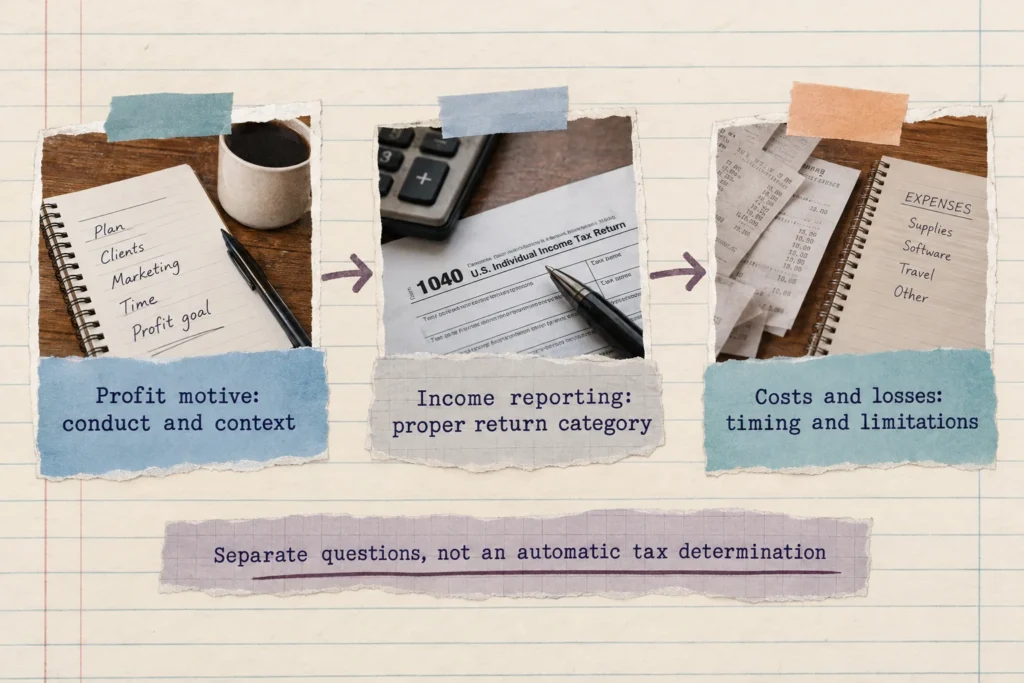
Business treatment doesn’t let you subtract everything you spent this year. When you have equipment or other property, the rules for when you can deduct the cost may be different, and at-risk, passive-activity, and excess-business-loss rules may still apply to restrict a business loss. You should consider carefully before filing if you plan to take a large loss and reduce the tax on your wages or salary. You usually need support for three separate things: the profit motive, the costs you claim for the year, and how much of the resulting loss you can actually use.[5]
Bring the decisions, not just the receipts
Before you meet with a CPA or EA, I would create a short classification packet to show how you operated for the year. The purpose is not to create a more businesslike past after the numbers are in.
- A timeline of when you started offering work or products, how regularly you operated, and the time you devoted.
- Year-by-year income and expense summaries, with startup spending, equipment, inventory, and personal use identified separately.
- Dated pricing calculations, customer outreach, contracts, and changes you made after reviewing results.
- Training you may have taken or advice you may have received.
Experience or prior training you may have.
Support for things you may have cancelled doing and other things beyond your control.
- Your expectation for appreciation of business assets.
Any other personal use of the assets or other income you may have.
If you have repeated unexplained losses, substantial personal use, irregular work, unreliable goods sold costs, or a loss you wish to offset against wages, bring that packet to a CPA or enrolled agent before filing the disputed treatment. The totals alone will not resolve these questions. Questions you should ask include “What facts support or refute my profit motive? Is this repeated, consistent, and ongoing sufficient to report on Schedule C? Which costs should be reported in this year as opposed to next year? What is the correct income I should report if it is a hobby? What is the correct income I should report if it is a business?” I would address these questions during the meeting as opposed to “is my LLC official”.[3][5][7][8]
Sources and references
- Internal Revenue Service: Is that activity just a hobby or a business? (2026-06-02)
- Internal Revenue Service: Income & expenses FAQ
- U.S. Treasury; text hosted by Cornell Legal Information Institute: Treasury Regulation § 1.183-2
- U.S. Congress; text hosted by Cornell Legal Information Institute: Internal Revenue Code § 183
- Internal Revenue Service: Instructions for Schedule C (Form 1040) (2025)
- U.S. Congress; text hosted by Cornell Legal Information Institute: Internal Revenue Code § 67
- U.S. Treasury; text hosted by Cornell Legal Information Institute: Treasury Regulation § 1.183-1
- Internal Revenue Service: Publication 525 (2025), Taxable and Nontaxable Income
- Internal Revenue Service: Publication 5558, Activities Not Engaged In For Profit Audit Technique Guide (2021-09)
- Internal Revenue Service: 2026 draft Schedule 1 (Form 1040)
