


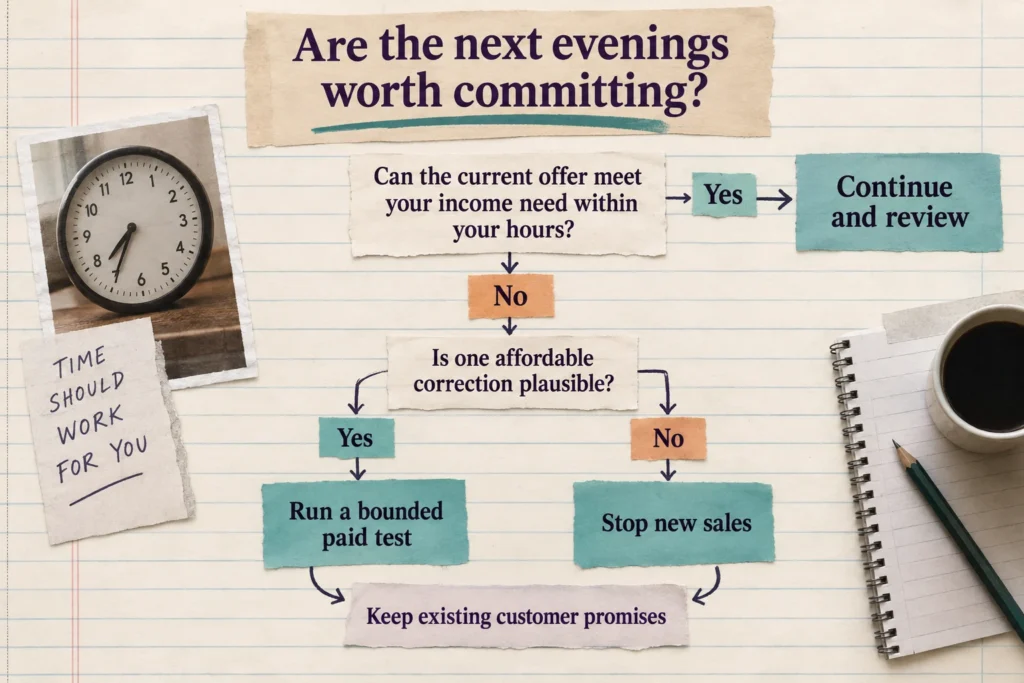
Dont take new orders once you realize the business and any specific change you can afford to test has no viable path to the money you need in the hours you can sustainably give it. Sales tell you someone wants what you’re selling. They don’t say giving up another month of nights is a good idea.
I wouldn’t tell you to pass up needed income because the hourly rate looks bad. But I also wouldn’t suggest another “work harder” spiral. The real question is what would need to change for buyers to accept it and what’s the risk of doing this without creating a bigger cash flow or workload problem.
Imagine, in a hypothetical situation, that after finishing a paid order I closed my laptop. Then I see three customer orders and an invoice I’ve yet to send. I’m briefly annoyed. A sale looks complete but my night isn’t. Rather than accept another identical order, I take a moment to consider what each sale really means. That “invisible” work needs to be considered as well.
Find what another sale actually fixes
Your transaction, expense, refund, and time records should address three key questions. The revenues less variable costs represent the ‘contribution’ (the dollars available to cover fixed operating costs). The fixed costs are subtracted once to get operating profit less owner compensation. This is illustrated in [Purdue Extension’s break-even analysis](https://ag.purdue.edu/department/agecon/fambiz/_docs/estate-personal-finance-planning/estimating_breakeven_sales.pdf). If you haven’t charged your labor as an expense, operating profit less owner compensation divided by all business hours will show the compensation per hour. This isn’t a wage you take in addition to the operating profit.[2]
Write down all the activities performed for the sale including: prospecting, content used to attract buyers, quoting, administration, delivery, revisions and support. Cash acquisition costs should be included, but the same bill should not be subtracted for overhead and for each sale. Our guide to [calculating real hourly earnings](https://sidehustleledger.com/calculate-real-hourly-earnings-freelance-side-hustle/) covers the fuller calculation. Here, we will refer to the numbers as inputs to a choice.
- Consider costs for a low contribution sale. What is the price versus the cost to provide the service or product? What are the materials, fees, refunds? Consider the cash acquisition costs. Are you spending a lot of time doing a low volume sale with little return?
- If overhead is high but the contribution margin is good consider removing a cost that occurs frequently. This can be done by stopping the sale but costs for the month are still payable.
- Delivery or support eats the evenings: consider a narrower package, fewer revisions, or fewer custom options, but check whether buyers still want what remains.
- Selling takes too long: distinguish reaching suitable buyers from persuading them. Few qualified prospects may suggest a channel problem. Repeated rejection of a profitable package may suggest an offer or demand problem, though poor targeting can also explain it. Neither clue settles the diagnosis alone.
- Profit exists but cash hasn’t arrived: check unpaid invoices, payout delays, and upcoming bills. Earlier collection can help with timing; it can’t repair weak margins.
Choose the change that addresses the biggest constraint. If acquisition already consumes your spare capacity, a plan that requires twice as many customers isn’t much of a rescue. I’d rather see one plausible correction than a new website, a new platform, and a new recurring deadline.
Put the income need beside the hours you have
Write down your minimum cash contribution to household needs and your maximum business hours for the next review period. Use hours you can give without borrowing from your main job, household commitments, or necessary rest. There’s no universal acceptable margin or hourly rate; your required amount and available evenings matter together.
Keep the cash target separate from pretax profit. If you need $650 available to spend, $650 of operating profit may not provide it after a tax reserve, delayed payments, or other cash commitments. Translate your household need into the business earnings and collection target it requires; don’t apply someone else’s tax percentage.
Three choices for the same four weeks
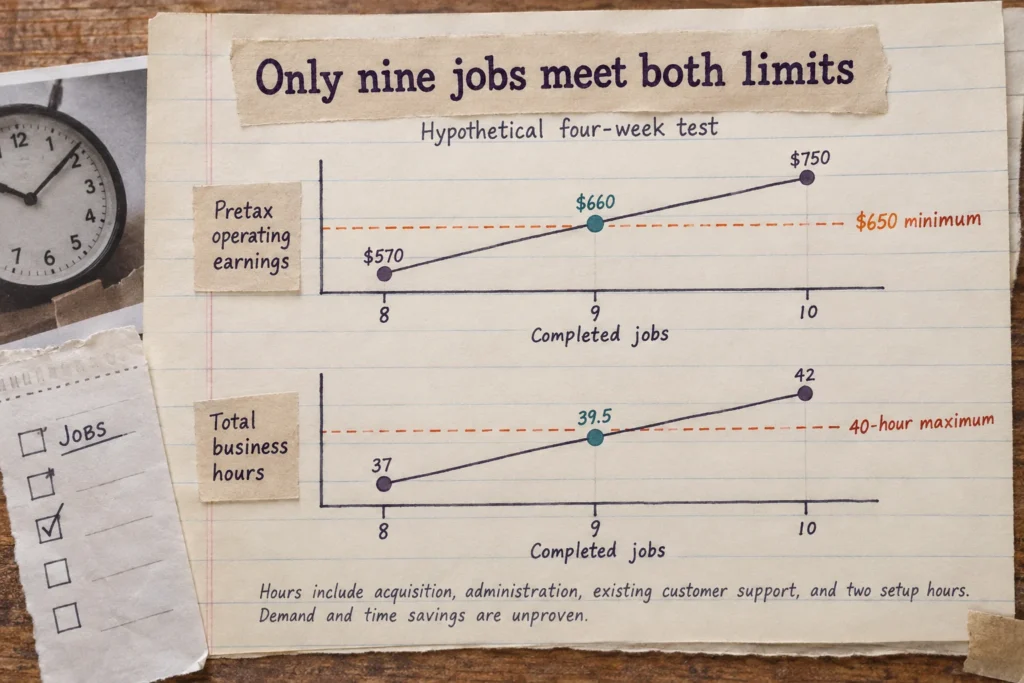
This is a hypothetical example of a service business, not a result. Its owner chooses a $650 pretax operating-earnings floor and a 40-hour ceiling for four weeks. New jobs are completed and paid within the week, and costs are paid as well. Existing customers have 4 hours of support time. No deliveries or refunds are needed. The support time is kept in all options.
| Choice | Earnings calculation | Total business hours | Fits both limits? |
|---|---|---|---|
| Continue unchanged | 12 jobs × $100 revenue, less $25 variable cost per job and $150 fixed costs = $750 | 42 delivery/support + 8 acquisition + 6 administration + 4 existing support = 60 | No: too many hours |
| Test one standardized, narrower package | 9 jobs × $120 revenue, less $30 variable cost per job and $150 fixed costs = $660 | 22.5 delivery/support + 8 acquisition + 3 administration + 4 existing support + 2 setup = 39.5 | On paper only |
| Stop new sales | No new sales income; $40 unavoidable cost remains. Separate exit cash calculation below. | 4 existing support + 1 closing administration = 5 | Frees time but does not meet the income need |
The narrower package replaces custom work with a standard deliverable and one revision. The forecast assumes buyers will accept $120, delivery and support will fall to 2.5 hours per job, and nine paid jobs can be won within eight acquisition hours. Those are the things to test, not benefits to take on trust. Removing something customers value could mean fewer orders or more questions. The unchanged offer earns more, but only by exceeding the owner’s capacity by 20 hours.
Each corrected job contributes $90. Using the fixed-cost and contribution approach described by the [SBA](https://legacy.sba.gov/business-guide/plan-your-business/calculate-your-startup-costs/break-even-point), and adding an earnings objective as in [Purdue Extension’s guidance](https://ag.purdue.edu/department/agecon/fambiz/_docs/estate-personal-finance-planning/estimating_breakeven_sales.pdf), the owner needs ($150 + $650) ÷ $90, rounded up: nine jobs. Acquisition, administration, existing support, and setup are forecast to consume 17 hours, leaving 23 hours for delivery. At 2.5 hours per job, that allows nine whole jobs too. These calculations show a possible fit; they don’t establish demand.[1][2]
With the given assumptions, eight jobs leave $570 and do not meet the earnings floor. Ten jobs leave $750 and require 42 hours. Nine jobs work with a half hour to spare. I’d only test this if the owner can afford the downside and is capping new commitments. One more support exchange could eliminate the cushion, so meeting the sales target would not be reason enough for me to continue testing.
Give the correction a chance, not an open-ended lease
Buy enough time to deliver your support or refund. Four weeks may work for this hypothetical service, but not for a customer who needs six weeks to approve the service. You can wait for the evidence without continuing to spend.
Choose cash-loss limits that don't put essential bills at risk. Set up a time allowance, and set a new order limit. For the purpose of this example, let's say the forecast allows for two setup hours and nine jobs, not a tenth order squeezed into a fully scheduled week. Keep going only once you're paid in acceptance, the actual costs have been collected, the collections have been made, and your total hours worked have been accounted for. Measure acquisition and support as they happen, even if they break your nice forecast. Praise isn't pay, and projected time savings aren't evenings recovered.
Stop accepting new orders when you reach your loss limit. Actual delivery times will make the hourly ceiling unrealistic. You're not able to win and complete enough paid jobs within the restriction to achieve capacity. This doesn’t cancel orders already accepted. At most, you could allow one extension for specific evidence, like agreed-to payment and/or a buyer’s decision that is currently out of your control and would make delivery of the order affordable. “Maybe next month” is not pending evidence. Successfully passing a short test extends the bounds of your work. It's not a guarantee that seasonal demand or later adjustments to your cancellation policy won’t change the result.
Stopping new sales still leaves a few things to finish
Past spending and effort don’t improve the next order’s economics. What matters now is what differs between your choices: refundable balances, equipment you can sell, avoidable subscriptions, termination charges, and promises still owed to customers. That distinction between sunk spending and relevant future costs is explained in [OpenStax’s managerial-accounting guidance](https://openstax.org/books/principles-managerial-accounting/pages/10-1-identify-relevant-information-for-decision-making). Keep the old costs in your records. You don’t have to buy another month of work to justify them.[3]
In our hypothetical exit, $110 of the $150 fixed costs can be avoided, $40 remains payable, and cancellation costs another $30. If we sell an unused asset for $80, we have a net one-time cash flow of $80, $40, $30 = $10. The $40 is the remaining cost shown in the table. The $10 is not recurring income, and the cash isn't available until the proceeds are collected. The five wind-down hours remain real.
Once the order intake is closed, avoidable renewals should be canceled, and promised deliveries, supports, refunds, and invoice payments should be completed. If an obligation is closed without fulfillment, then resolve the situation with the customer. After the business is closed, final federal reports should be completed, taxes owed paid, and bookkeeping records kept; state requirements may also apply.[4]
If the cash flow is negative and you need to wind down the business, then a bounded transition may be warranted. You would need to finish work for customers that have terms that are bound by the transition, with a defined end or review date. Stopping work does not provide an income, but it allows you to stop making promises to perform work that will not contribute to meeting your needs.
Sources and references
- U.S. Small Business Administration: Break-even point
- Purdue University Extension: Estimating Breakeven Sales for Your Small Business, EC-725
- OpenStax, Rice University: Identify Relevant Information for Decision-Making
- Internal Revenue Service: Closing a business
