


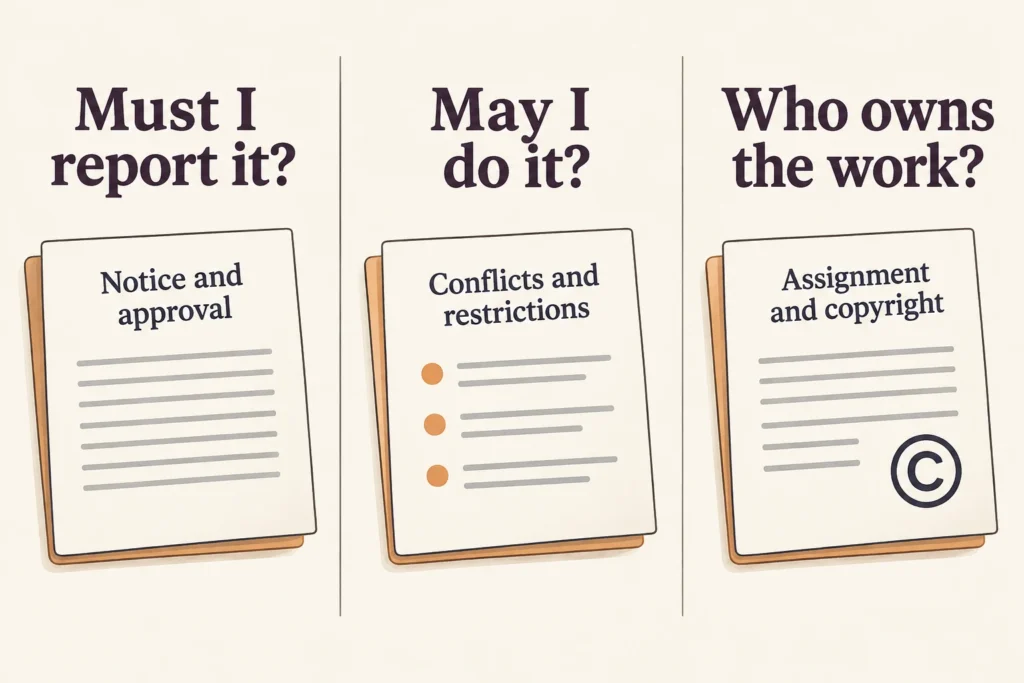
No, not automatically. There are several things to consider, including the employment documents, applicable laws, and the policies pertaining to your job. There is also the issue of whether there is a conflict or an ownership issue. Disclosure is not always required, and permission does not always resolve an issue.[1][2][4][5][8][10]
I’d start with the documents, not a casual “Would you mind?” to your manager. You’re trying to protect the paycheck that covers essential bills, while keeping room to earn more. A specific question gives you something more useful than either secrecy or vague permission.
Find the clause that actually covers your work
Start with your signed employment agreement and amendments, current handbook, code of conduct, and any separate confidentiality or invention-assignment agreement. Search for “outside employment,” “moonlighting,” “outside business activities,” “conflict of interest,” “exclusive services,” “inventions,” and “assignment.” If a public policy points to internal rules, get those too, the answer may be in the document you haven’t opened yet.[1]
For each relevant clause, note the activities covered, the reporting trigger, the deadline, the recipient, and the required form. “Notify your supervisor” is not “obtain prior written approval from compliance.” Nor is “outside business activity” necessarily limited to a second payroll job: the wording may cover ownership, consulting, unpaid work, or expected compensation.[2][8]
Imagine I’m about to accept a Saturday photography booking, pleased that it has nothing to do with my office job. Then I find a clause requiring prior approval for “any outside business activity.” The client needs an answer tonight. I’m annoyed by the delay, but I hold the booking while I resolve approval; unrelated work can still fall under broad wording.
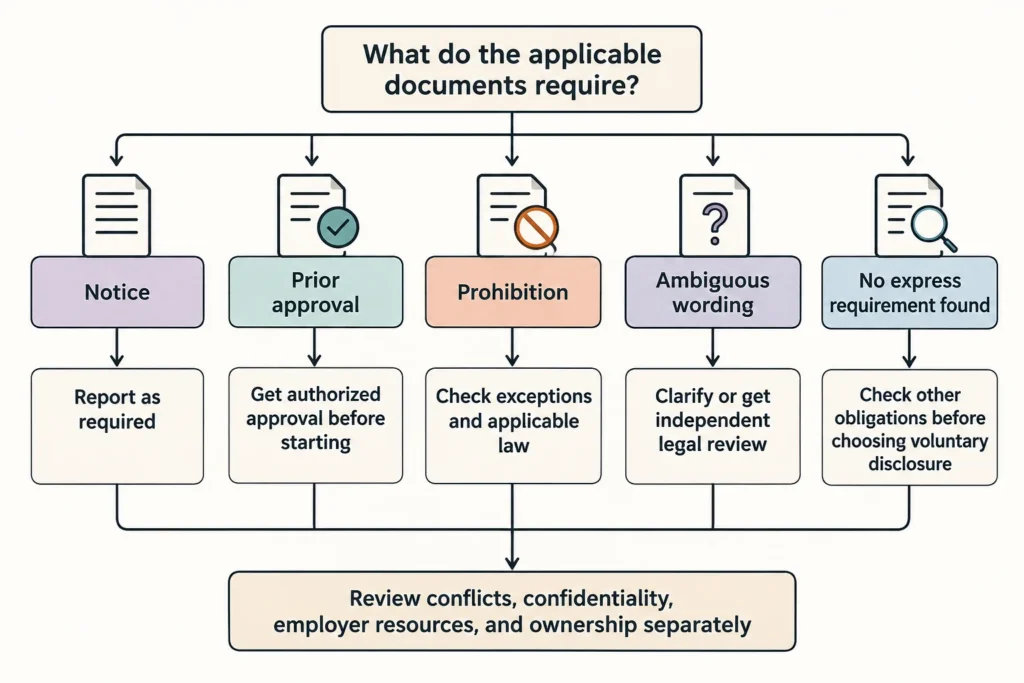
Notice, approval, or neither?
- If the clause requires notice, report the covered activity to the named person by the deadline. That's all the reporting requirement is concerned with; the activity may still be restricted.
- Prior approval means, well, prior approval. A friendly email from your boss may not count.
- If it prohibits the activity, telling someone doesn’t override the prohibition. Before committing, check the stated exceptions and whether applicable law limits the restriction.
- If it's unclear what the clause means, figure out the specific part and the related facts that create the ambiguity. Is it a process question? Check with the company. Is it a disputed restriction? Call your own lawyer.
- If there’s no clear stipulation, check occupational rules and the other constraints below. Before disclosing the information voluntarily, consider the policy vacuum. Doing work outside of your job isn’t always going to be okay.
I wouldn’t blindly follow “my boss knows” without determining who can actually approve the work. Carlyle’s January 2023 SEC-filed code required supervisor review followed by a final review by designated compliance or legal authorities. While this is a historical example, not Carlyle’s current code, it illustrates why the person reviewing the work is important.[2]
The same skill isn’t the same as the same conflict
Relying on your skills outside work to address the conflict of interest is not by itself sufficient. I’d consider who pays you, what you deliver, and the decisions you control at your main job. Industry overlap is a potential area of interest, not a definitive answer.
- Client or Competition: Would you represent a competitor? Approach your employer’s customers? Take an opportunity that belongs to your employer?
- Vendor influence: Would your side client benefit from your purchasing decisions, referrals, or other business decisions?
- Confidentiality: Would your side client benefit from what you learn about your employer’s customers or plans? Would your side client benefit from what you learn about your employer’s research or code?
- Job Duties: Are there conflicts between the duties you owe your employer and your outside obligations?
Would your side client benefit from what you learn about your employer’s customers, research, or plans? Are outside obligations conflicting with your performance obligations?
Employer Resources: Would your side client benefit from your use of your employer’s resources?
Resource: I’d maintain a strict firewall between my side work and my employer’s resources, including the company laptop, email, accounts, and time. The use of employer resources for side work would only be permitted if the employer’s policies allowed it. I’d also review Microsoft’s Conflict of Interest Policy which separates tech resources, confidential information, and outside work.[1]
Your own laptop doesn’t settle ownership
While equipment and hours resolve some ambiguity about work ownership, there’s still a gap I’d be most hesitant to leave unresolved. This is the scenario where you could get permission to run a business, but an assignment clause still allows your employer to make a claim to your work.[4][5][6]
There is a good reason to address reporting and ownership separately, as illustrated by California. The draft 2025 reproduction of Labor Code § 2870 limits the assignment of inventions made outside the workplace. There are exceptions: an invention may still fall under an assignment provision if it relates to the employer’s business, or if it is made in the course of the employer’s business, or if it was made in anticipated research or development.[4]
The same reproduction of § 2871 allows for provisions in contracts of employment requiring the employee to keep inventions confidential and to grant the employer the right to review and evaluate such inventions. This section does not require every employee to report every invention made during the employment. The official California pages were not retrievable for this article, therefore these reproductions show the language of the provisions but do not confirm the language that is currently in effect. Should your project rely on these provisions, you should review the current language and your full agreement to ensure it before you assign ownership to your client.[4][5]
Copyright asks a different question. The U.S. Copyright Office states that an employee’s work created in the scope of their employment can be a work made for hire, with the employer entitled to claim copyright, and be considered the author, unless there is a written agreement to the contrary. “I made it at home,” does not answer whether it was created in the scope of your employment, and California’s Invention Protection is not a general copyright exemption.[4][6]
Check the rules beyond your handbook
“It’s legal, and I do it after work” is not an absolute defense, either. New York Labor Law § 201-D defines protected recreational activities as activities for which the individual receives no compensation, and you can’t rely on that recreational provision as a defense for paid side work, but that doesn’t mean every employer restriction on paid side work is legal.[3]
If you are a FINRA-covered registered person, the outside-activity rules are worth a separate look. Published Rule 3270 requires written notice for covered activities, and allows firms to impose conditions and prohibit the activity. Replacement Rule 3290, which the SEC approved on September 15, 2026, will be effective on the same date as the first rule. As of October 7, 2026, the materials reviewed did not establish an implementation date for the new rule. Before you begin the activity, contact compliance to determine which rule to follow and how to notify compliance. Notice to compliance does not mean the rule has been replaced, and the replacement is not immediate.[8][9]
For federal employees, agency supplemental regulations can mandate prior approval for outside employment. The obligation to obtain approval is dependent on the agency’s regulations, not a requirement for all federal employees.[10]
Ask a bounded question, and know who’s answering
When answering a process question, tell the designated recipient who the client is, what you will deliver, and when, and whether employer resources or information will be involved. Then, ask “Under [policy section], does this require notice or prior approval, and who issues the written decision?” Keep the response and its conditions. If an assignment clause could potentially cover the work, ask whether the response also answers the question of ownership, don’t assume it does.
I would seek an independent legal opinion on employment before accepting work if it may involve “related business” or “anticipated research” and there is a risk the work involves a valuable product, or the client may be the same as your employer. For example, remote work may raise state law competing claims (assuming you are in a state that has competing work laws)). You need to answer the question of what the clause covers and whether the clause is enforceable, not just complete the form.
While HR can walk you through a process, that doesn’t make the conversation privileged. Generally, company counsel represents the organization, not you. If there’s a restriction or you need to disclose confidential information, stop what you’re doing and get your own legal advice. Telling the company about the restriction won’t make it go away.[1][2][7]
If there are no reporting requirements and you’ve resolved any conflicts or ownership questions, then voluntary disclosure is a judgment call. You may decide to make disclosure to avoid potential surprises if the work you’re doing becomes publicly known or overlaps with your employment in an unmanageable way, but that’s not the same as saying you’re obligated to get the company’s permission to disclose.
I’d figure out what I was obligated to report and if there was a conflict or ownership question, before committing to a deadline to deliver the work to the client. I’d do that especially if there was a chance I could get in trouble for disclosing the information or doing the work.
Sources and references
- Microsoft: Microsoft Standards of Business Conduct
- The Carlyle Group: Carlyle Code of Conduct, January 2023, SEC-filed exhibit (2023-01)
- New York State Senate: New York Labor Law § 201-D
- Justia: California Labor Code § 2870, reproduced statutory text
- Justia: California Labor Code § 2871, reproduced statutory text
- U.S. Copyright Office: Circular 30: Works Made for Hire
- American Bar Association: ABA Formal Opinion 514 (2025-01-08)
- FINRA: FINRA Rule 3270: Outside Business Activities of Registered Persons
- U.S. Securities and Exchange Commission: SEC approval of FINRA Rule 3290 replacement (2026-09-15)
- Office of the Federal Register and Government Publishing Office: 5 CFR § 2635.803: Prior approval for outside employment and activities
