


While we await more clarity, we can focus on the 2026 taxes for U.S. sole-proprietor side-hustle income. For now, base your tax reserve on estimated net business profits, not the platform payout. A temporary percentage, like 30% of profit, can be used to set aside some cash while the calculation is being finalized. The true target is the anticipated household tax bill for the year, less paycheck withholding and any payments already made, with state taxes calculated separately. 30% is neither a personalized target nor a hard ceiling.[1][2][5]
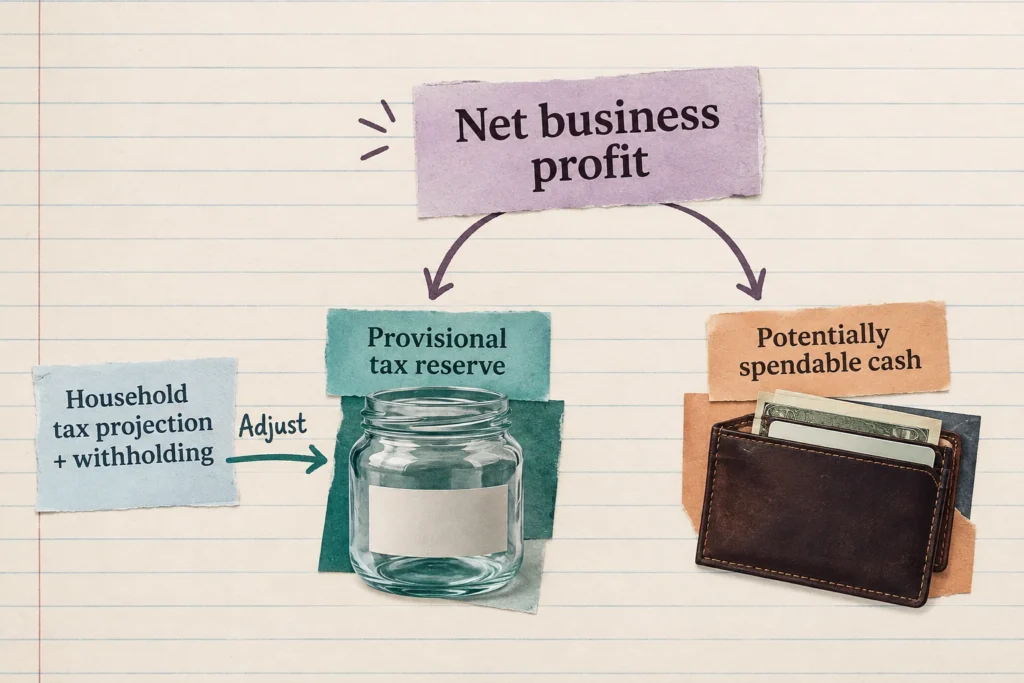
I’d use the percentage, then replace it with a more concrete dollar amount. To adequately fund your “family fun money” account, you need to know what you can afford to spend, but you can’t be forced to leave that money untouched because of a random number someone picked.
Start with the profit hiding inside the deposit
Remember, a bank notification tells you what arrived, not what you earned. A payment platform may charge fees and take them out of your gross payment total, but you still receive the net payment. To determine your net profit, subtract fees and other business expenses.[1]
| Item | Amount | Calculation or meaning |
|---|---|---|
| Gross customer receipts | $1,000 | Revenue before fees |
| Platform fees | , $50 | Withheld before the deposit |
| Bank deposit | $950 | $1,000, $50 |
| Other deductible expenses | , $250 | Paid from the deposited cash |
| Net business profit | $700 | $1,000, $50, $250 |
| Provisional tax reserve | , $210 | $700 × 30%; held, not paid to the government |
| Cash potentially available to spend | $490 | $950, $250, $210 |
Imagine I’m looking at that $950 deposit with a $250 business-software bill open in another tab. I'm somewhat happy to receive the payment, and somewhat annoyed because I mentally spent that money twice. I pay the bill first to leave $700 profit, and move $210 to tax savings. The $490 is a much better indicator than the bank notification.
$490 is not available in full. Expenses are paid and cash profit is taxable profit. Cash profit matching taxable profit occurs only because the example has no inventory, equipment purchases, depreciation, or unpaid business bills. For those, calculate available cash and treat the rest as taxable profit.
Why the same profit can need different reserves
The federal bill includes self-employment tax and income tax. In the ordinary calculation, 92.35% of the net profit is subject to 12.4% Social Security tax and 2.9% Medicare tax. Your wages count towards your own 2026 Social Security wage base of $184,500, so a high-paying main job can limit the Social Security portion of your side-hustle earnings. At higher amounts, the Additional Medicare Tax comes into play.[2]
Let’s say the example’s $700 monthly profit continues for a year, resulting in $8,400. If your wages and self-employment income for the year stay under the cap for Social Security, ordinary self-employment tax would be roughly $1,187; $8,400 x 92.35% x 15.3%. You can deduct half of this when figuring your federal income tax. This distinction is worth noting before you make your budget.[2]
Let's take the two examples to compare the two households. Assume full eligibility for the 20% qualified business income (QBI) deduction and enough taxable income to utilize it. Also assume no other related business deductions, credit changes, Additional Medicare Tax, or state tax. Taking half the self-employment tax leaves about $7,807. The $1,561 QBI deduction leaves about $6,245 subject to federal income tax. QBI reduces income tax, not self-employment tax.[2][7]
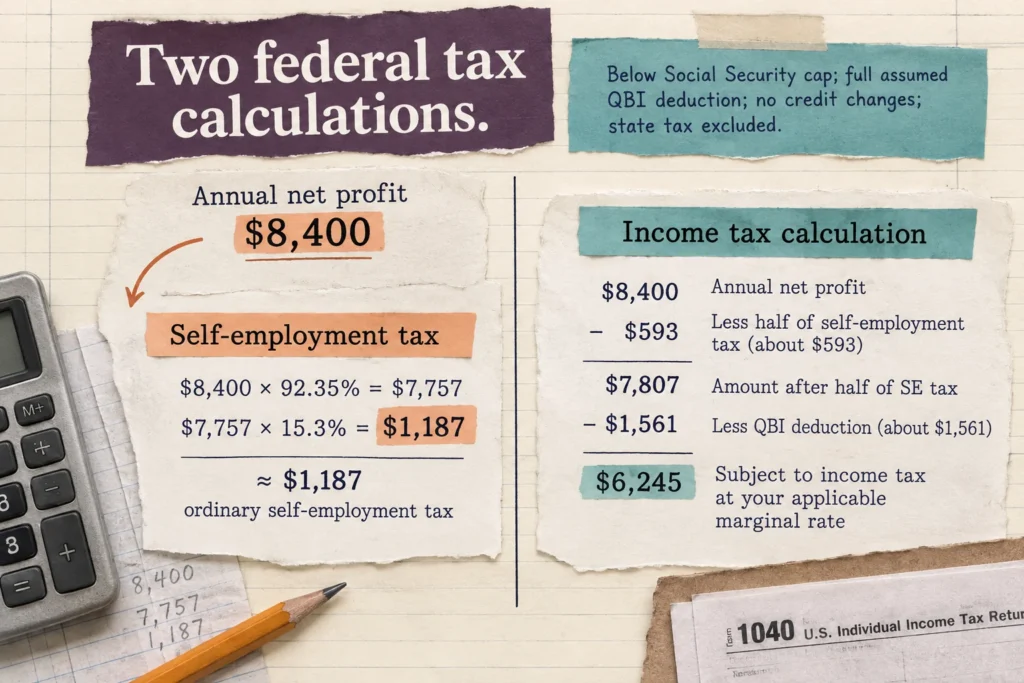
If all of your $6,245 falls in the 12% bracket, income tax is about $749. The self-employment tax is $1,187, raising the total to $1,936, or 23.1% of profit. In the 22% bracket, income tax is about $1,374, bringing the total to $2,561, or 30.5% of profit.[2][7]
Your 30% reserve would cover $2,520. This amount is slightly less than the second federal estimate and somewhat more than the first. It doesn’t include any amount for state taxes. Without the assumed QBI deduction, both the first and second federal estimates increase. This is why “30%” can’t be considered an answer. The same profit from a business can result in different taxes owed based on the other returns you file.[2][7]
Your paycheck may already be funding part of the bill
Reserving that entire amount for business income requires that the other members of your household not cut back as well. The other members of your household could include your spouse if you file a joint return, or other dependents. Their wages and other income as well as deductions and credits can lessen the tax burden and offset your business income. Self-employment tax is not withheld from your pay and will have to be paid quarterly, along with income tax. The withholding from your pay for Social Security and Medicare does not qualify as excess withholding.[2][5][9]
A hypothetical household projection has the federal tax after credits at $12,000 and full-year withholding at $10,000. Estimated payments of $500 have already been made, so $1,500 in taxes remain to be paid. $900 of the taxes have already been saved. How much more do you need to save? Another $600. Saving the money doesn’t reduce the tax bill.[5]
You can use the IRS Tax Withholding Estimator to help create a projection of your federal income taxes if you are also receiving wages. Have recent pay stubs for both spouses if filing a joint return. Also have a copy of your most recent return, your estimated annual business receipts and expenses, other income, estimated payments you have made, and any expected changes to your business.[4][6]
To use the estimator, use the line on your pay stub for federal income tax withholding. Leave out state income tax, Social Security, and Medicare. To get a quick estimate of your full year federal income taxes, add your year-to-date federal income tax withholding to the expected federal income taxes withheld from your paychecks for the remainder of the year, adjusted for any bonus income or changes to your pay.[3][5]
If you reduce your federal income tax withholding by changing your Form W-4, you need to update your projection. I don't want you to squeeze your spending twice. The first time will be from a smaller paycheck, and the second time will be from not having the business funds to cover the taxes that were already withheld. Also, do not enter your tax savings as estimated payments made. That should only be used to enter payments you have actually made.[3][5][9]
Saving the money and paying on time are different jobs
Money in savings doesn’t satisfy a payment deadline. For 2026, federal estimated payments are generally required if you expect to owe at least $1,000 after withholding and refundable credits, and that withholding plus refundable credits is less than the smaller of 90% of current-year tax or 100% of prior-year tax. The prior-year target rises to 110% if prior-year adjusted gross income exceeded $150,000, or $75,000 if married filing separately. The prior return must cover 12 months; special rules and exceptions apply.[2]
Those numbers only address underpayments, not the entire bill. You can hit a prior-year safe harbor through timely payments and still owe more at filing. I would look at two numbers, what do I need to get to the IRS this year, and what cash do I need to pay the final balance.[2][9]
The standard calendar-year federal installment dates are April 15, June 15, September 15, 2026, and January 15, 2027, subject to applicable relief or special rules. The good news is that an underpayment for a given period can be made up in a later period. If you’re planning on making estimated payments, be wary that withholding is generally allocated across payment periods, and increasing your withholding may help, but I can’t say for sure that it eliminates the penalties. For fluctuating income, the annualized-income calculation and Form 2210 may help show when the money is received.[2][3][9]
Don't copy the federal payment plan for your state. For California, for instance, the estimated payment threshold is generally $500 or $250 for married/RDP filing separately, and a regular installment split is 30%, 40%, 0%, and 30%. California state withholding is done by using Form DE 4 instead of the federal Form W-4. The differences affect when cash is available, and California's exceptions and income-based rules can change the calculation even more.[8]
If you’ve missed an installment, have uneven earnings, work in different states, have inventory/equipment that creates a disconnect between cash and taxable profit, or a myriad of other issues, the percentage shortcut leaves many unanswered. Gather your pay stubs, prior return, and year-to-date business totals, and ask a CPA or Enrolled Agent to calculate the payments, any prior period shortfall, and the reserve that is needed. Without that, you’ll need to constantly reevaluate your projection when profit or household pay changes, especially before payment dates. Because the account balance is looking tempting, doesn't mean it's a good time to release the savings.
Sources and references
- Internal Revenue Service: What to do with Form 1099-K
- Internal Revenue Service: 2026 Form 1040-ES (2026-02-12)
- Internal Revenue Service: Publication 505 (2026), Tax Withholding and Estimated Tax
- Internal Revenue Service: Tax Withholding Estimator
- Internal Revenue Service: Tax Withholding Estimator FAQs
- Internal Revenue Service: Tax Withholding Estimator, Income & tax payments
- Internal Revenue Service: Qualified business income deduction
- California Franchise Tax Board: 2026 Instructions for Form 540-ES Estimated Tax for Individuals
- Internal Revenue Service: Estimated taxes
